How to Generate More HVAC Leads Every Month
Earn and buy HVAC leads the right way: real cost ranges, shared vs exclusive, the consent rules, and the one metric that matters.
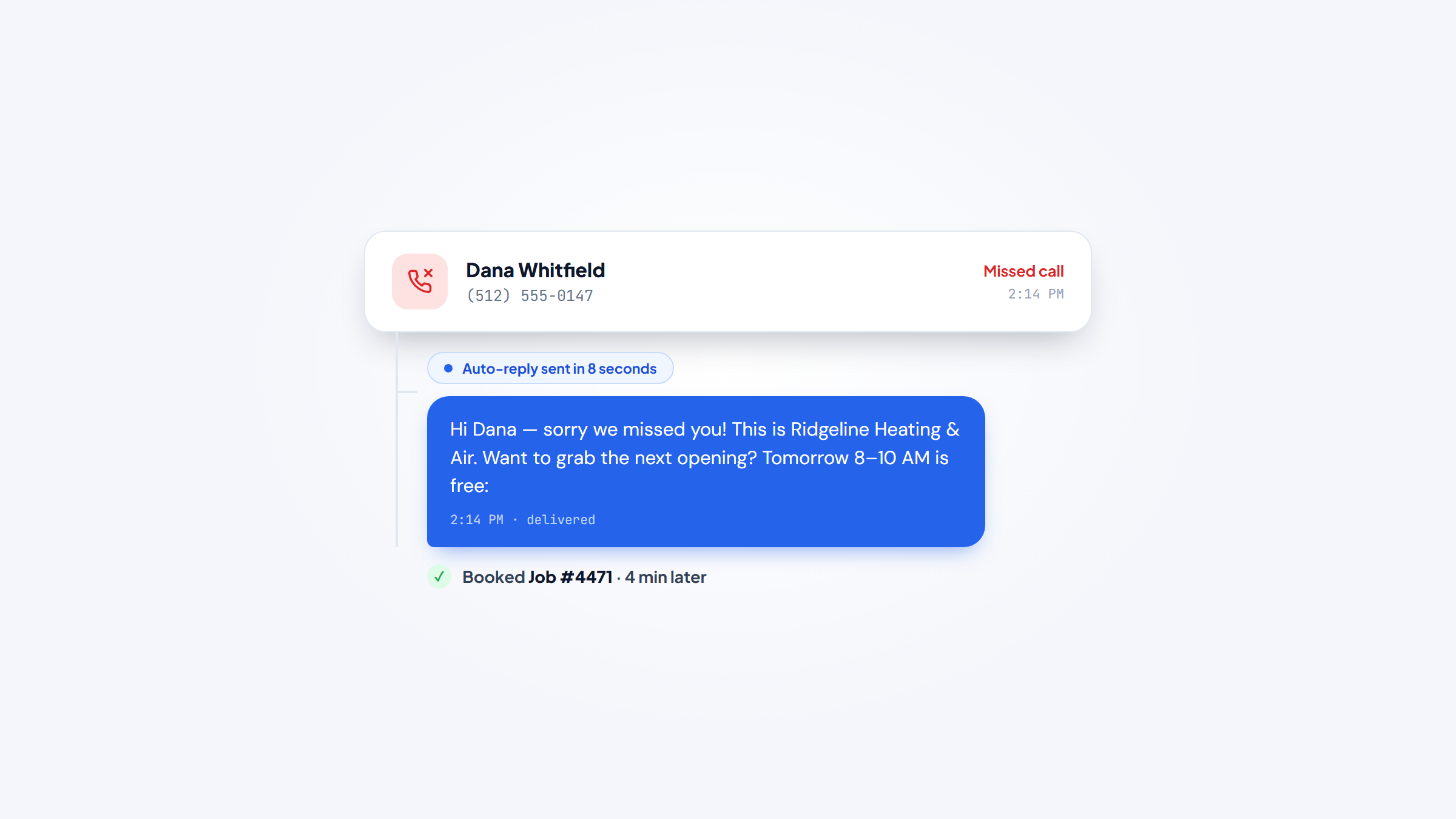
Every HVAC contractor wants more leads. Fewer can tell you what a lead costs them, and fewer still can tell you what a booked job costs them, which is the only number that decides whether the marketing is working.
The market for HVAC leads is noisy on purpose. Marketplaces sell the same homeowner to four contractors, agencies quote retainers with no floor, and the statistics floating around this topic are mostly recycled from vendor blogs.
This guide splits the problem in two: how to earn leads you own, and how to buy leads without getting taken. It also covers the consent rules that apply the moment you call or text a purchased lead, because that part carries real liability.
What Counts as an HVAC Lead
Volume is the wrong goal. A phone number attached to a person who wanted a price on a part they can buy at a hardware store is not worth what a replacement inquiry is worth.
Sort every lead into three tiers, and track them separately.
Tier | Definition | What it tells you |
|---|---|---|
Valid | Real contact info, genuine intent | Whether the source is sending real people |
Qualified | In your service area, needs work you do, ready to talk | Whether the source is sending your people |
Billable | Became scheduled, paying work | Whether the source is worth the money |
Most contractors only count the first tier and then wonder why the marketing spend does not show up in revenue. A lead source can be 100% valid and near zero billable, which is exactly the profile of a shared marketplace lead.
The residential and commercial split matters here too. Residential leads run on urgency, close fast, and arrive when something breaks. Commercial leads for HVAC contractors have long cycles, involve property managers or general contractors, and are won on relationships rather than response time.
Earn Before You Buy
The channels you own keep producing after you stop paying. The channels you rent stop the day the invoice does.
Owned channels are your Google Business Profile, your organic rankings, your reviews, your past-customer list, and your referral relationships. Rented channels are lead marketplaces, pay-per-call networks, and ads. Both have a place, but a business built on rented leads has no equity in its own pipeline.
The order is straightforward. Get the owned channels producing first, then buy leads to fill the gaps, particularly in a slow season or a new service area. Buying leads to compensate for an incomplete profile and nine reviews is paying a premium for a problem you could fix for free.
The honest answer to how to get HVAC leads is that most of yours are already within reach: the customers you served, the neighbors who watched you work, and the profile you have not finished filling out.
The mechanics of the organic side are covered in our guide to HVAC SEO. The short version: a complete profile, real photos, and a steady stream of recent reviews.
The Channels That Produce Local HVAC Leads
Ranked roughly by cost per booked job, cheapest first, these are where local HVAC leads actually come from.
- Referrals. The best-converting, lowest-cost source in the trade. Define a reward, pay it on the completed job, and tell every customer it exists.
- Past customers. You already paid to acquire them. A pre-season tune-up reminder to a five-year-old list is close to free money.
- Google Business Profile. Where most emergency searches end. Free, and the fastest thing you can improve.
- Organic search. Slow to build, cheapest per lead once established, and it compounds.
- Google Local Services Ads. Pay per qualified lead or call rather than per click, with the Google Guaranteed badge.
- Google Search Ads. More expensive per booked job for most contractors, but immediate and controllable.
- Purchased marketplace leads. Fastest to switch on, most competitive, lowest booking rates.
Reviews sit underneath all of these. BrightLocal's 2026 survey of 1,002 US consumers found 47% will not use a business with fewer than 20 reviews, and 74% only weigh reviews posted in the last three months. A lead that finds you and then reads a stale review profile is a lead you paid for and lost.
One idea worth stealing, described by an HVAC instructor on Reddit: a contractor mailed customers a sticker for their thermostat reading "if your thermostat ever goes bad, call us for a free replacement." He reported over 500 calls, replaced five thermostats free, and picked up several repairs, a few installs, and a run of new customers from the goodwill. The offer was cheap because almost nobody's thermostat fails.
Buying HVAC Leads: Shared Versus Exclusive
When contractors say they want to buy HVAC leads, they usually mean a marketplace: you pay per lead, the lead arrives by text, you call it.
The first question is exclusivity. A shared lead is sold to multiple contractors at once, often up to four. You are racing three other companies to the same homeowner, who is now fielding four calls and shopping on price. An exclusive lead is sold only to you.
Prices vary by market, season, and job type. These are the ranges published by lead vendors and marketing agencies, not audited industry data, so treat them as a starting point and verify with any vendor before committing budget.
Lead type | Reported range | Exclusivity |
|---|---|---|
Shared marketplace lead | roughly $8–$85 | Sold to up to 4 contractors |
Exclusive lead | roughly $20–$300+ | Yours alone, job-size dependent |
Google Local Services Ads | roughly $18–$150+ | Per qualified lead or call |
Agency retainer | $1,000–$25,000+/month | Managed channels, not per-lead |
Now the part that matters more than the price. Suppose a shared lead costs $50 and you book one in ten. That is $500 per booked job. Suppose an exclusive lead costs $150 and you book one in three. That is $450 per booked job.
The lead that looked three times more expensive was cheaper. Cost per lead is the number vendors sell on; cost per booked job is the number that pays your techs, and it is a function of your close rate as much as the lead price. If price-shopping callers are killing your close rate, that is often a pricing and positioning problem, addressed in our HVAC pricing guide.
Pay-Per-Call HVAC Leads
Pay-per-call HVAC leads are a variant worth understanding separately, because the unit you buy is different. Instead of a form fill, you buy a live inbound phone call from someone who chose to dial.
The appeal is obvious: a person on the phone has more intent than a person who filled out a form and wandered off. Vendors typically charge more for these, and typically require the call to last some minimum duration before it bills.
The risks are specific. Read the terms for what counts as a billable call, whether a wrong-number or out-of-area call bills anyway, and what the dispute process is. Ask what happens when the caller wanted a service you do not offer.
Google Local Services Ads is the largest pay-per-lead channel most contractors touch, and its quality is not as controllable as people assume. One HVAC owner tracked it on Reddit across roughly ten weeks and about 90 reviews, and found lead quality suddenly cratered in one week even though reviews stayed strong.
Practitioners in the thread noted Google removed the ability to dispute individual bad leads directly. Their advice was to tag every bad lead by reason, wrong service, outside area, no answer, quote shopping, for a few weeks before assuming reviews are the lever.
That tagging habit is the actual advice. Without it you cannot tell a bad channel from a bad week.
The Consent Rules You Have to Follow
The moment you call or text a lead you purchased, federal telemarketing law is in play. This is not legal advice, and a lawyer should review your process, but the current state of the rules is worth getting right because most content on this topic is out of date.
The one-to-one consent rule is dead. The FCC adopted it in December 2023, and it would have required a lead generator to get separate consent for each individual company that might contact a consumer. It was due to take effect in January 2025.
Instead, the Eleventh Circuit vacated it in January 2025, holding the FCC had exceeded its authority under the TCPA. The FCC then formally removed the rule from its regulations in Order DA-25-621, released in July 2025 and effective that August.
So the older standard applies again: a single prior express written consent can cover multiple sellers, as long as the consumer is clearly told who may contact them. Lead generators do not need one-to-one consent per company.
Three practical points follow:
- Ask any lead vendor to show you the consent language the consumer actually saw, and which companies were named in it. That disclosure is your protection.
- Carrier rules are separate from FCC rules. T-Mobile, AT&T, and Verizon enforce their own one-to-one opt-in requirements for business text messaging, regardless of what the FCC does. If you text leads, you have to satisfy the carriers too.
- Do not confuse this with the revocation rule. A different FCC requirement, about honoring a single opt-out across all of a sender's messages, was delayed to January 31, 2027. Two separate stories.
Anyone still describing one-to-one consent as upcoming is working from an article written before April 2025.
How to Evaluate a Lead Vendor
Contractors have strong opinions about specific lead companies, and those opinions conflict violently. A better approach than picking a side is asking the same six questions of anyone selling you leads.
- Is the lead exclusive, and if shared, how many contractors receive it?
- What is the refund or credit policy for an invalid lead, a wrong number, or a contact outside your service area?
- How is a billable lead defined? Get it in writing, especially for pay-per-call.
- What consent language did the consumer see, and which companies were named?
- Can I cap spend and pause instantly, or am I locked into a monthly minimum?
- Can I see the lead source? A lead scraped from a form on an unrelated site behaves nothing like one from a search ad.
A vendor who answers these plainly is worth trying with a small, capped budget. One who deflects is telling you something.
Answer Faster Than Anyone Else
The most reliable way to increase booked jobs from the same number of leads is to answer the phone first.
Speed to lead gets quoted with a specific figure, that leads contacted within five minutes are twenty-one times more likely to qualify. That number circulates constantly in HVAC marketing content and traces back to a study from over a decade ago that is rarely linked. Treat the principle as sound and the statistic as folklore.
The mechanics are what matter. A homeowner with a dead system calls two or three companies and books whoever answers and can come today. If you buy shared leads, you are explicitly in a race, and a callback tomorrow morning is a callback to someone who already booked.
Route calls to a person during business hours, use an answering service or a call-back commitment after hours, and log every missed call as a lost lead so it shows up as a number instead of a feeling.
Track the Only Number That Matters
Cost per lead is what vendors report. Cost per booked job is what you should manage to.
For each channel, every month, record the spend, the leads produced, how many became scheduled work, and the average ticket of that work. Divide spend by booked jobs and you can finally compare a $15 organic lead to a $150 exclusive one on equal terms.
You need two things to do this: call tracking numbers, so each channel is attributable, and one place where the call, the job, and the revenue all land. For most shops that is a CRM for HVAC, and without it the tracking degrades into guesswork within a month.
Set a threshold before you start spending. If a channel consistently produces booked jobs above what a job is worth to you, cut it, no matter how good the lead volume looks.
Mistakes That Keep Contractors Short on Leads
The failures here are consistent, and none of them are exotic.
- Buying leads as the foundation instead of the supplement, so the pipeline dies the moment spend stops.
- Chasing cheap shared leads without measuring the booking rate.
- Depending on one channel, which works right up until an algorithm changes.
- Never asking past customers for anything, which is the cheapest list you will ever own.
- Not tracking anything, which makes every marketing decision a matter of opinion.
- Answering slowly, which quietly wastes every dollar spent upstream.
The contractors who consistently generate HVAC sales leads are not running a secret channel. They own their profile and reviews, they work their existing list, they buy leads deliberately to fill gaps, and they know their cost per booked job by channel.
Building a Month That Repeats
The real question is not how to get more HVAC leads, but how to get more booked jobs from a system that does not reset each month. Earn what you can, buy what you must, and measure both the same way.
Start with the free work: complete the profile, get to twenty recent reviews, and email your past customers before the season turns. Then test one paid channel with a capped budget, tag every bad lead by reason, and hold it to cost per booked job rather than cost per lead.
How much to spend across those channels, and how to sequence them across a year, is the subject of our guides to HVAC marketing and building an HVAC marketing plan. The leads follow the system, not the other way around.
Frequently asked questions
Complete your Google Business Profile, build a steady review habit, and email your past customers before each season turns. Add a written referral program that pays on completed jobs, and answer the phone faster than your competitors. These owned channels cost little, convert better than purchased leads, and keep producing after you stop spending, unlike marketplace leads that end with the invoice.

Still comparing HVAC software?
Filter 159 vetted tools by pricing, business size, and the features your shop actually needs. No signup, no sales calls.