HVAC Pricing Guide: How to Set Fair Service Prices
An HVAC pricing guide for contractors: markup vs margin, your true hourly cost, flat rate pricing, price books, and commercial pricing.
Most HVAC contractors do not have a pricing problem. They have a costing problem, and it shows up as a pricing problem when the year ends and the profit is not there.
The math is not difficult, but it is unforgiving. Miss the difference between markup and margin and you will undercharge on every job for a decade. Forget that a technician paid for forty hours only bills twenty-eight of them and your hourly rate is fiction.
This HVAC pricing guide for contractors is written for the person setting prices, not the homeowner shopping for one. It works through what a billable hour truly costs, how to set a margin you can defend, how flat-rate pricing and a price book fit together, and where commercial work follows different rules.
What an HVAC Pricing Guide Has to Get Right
Pricing an HVAC job is one equation, applied consistently:
Price = (labor + materials + overhead) ÷ (1 − your target margin)
Every part of that is a number you have to go measure. Labor is not the wage. Overhead is not "some percentage." And the divisor, not a multiplier, is what separates contractors who hit their margin from contractors who think they did.
Everything below is a way of filling in one of those terms accurately. Get them right and the price sets itself, whether you present it as flat rate or bill it hourly.
Flat Rate Versus Time and Materials
Two pricing models dominate the trade, and the argument about them is louder than it needs to be.
Time and materials bills the customer for the hours worked plus the parts used. It protects you when a job runs long and feels familiar to commercial buyers. It also punishes efficiency: the faster your best technician works, the less you earn, and the customer watches the meter run with visible anxiety.
Flat rate quotes one price for the job before work begins, drawn from a price book. The customer knows the number up front, your efficient techs become more profitable rather than less, and the sticker shock happens once, in the driveway, instead of at the end.
Contractors on Reddit put it more bluntly than any vendor guide. In one long-running thread, a commenter argued that the successful companies are flat rate and the struggling owner-operators are time and materials.
The most useful reply in that thread pushed back: flat rate is not easier, and knowing your costs is what lets you price properly regardless of model. That is the correct read. Flat rate rewards a contractor who knows their numbers and quietly punishes one who does not, because a mispriced flat rate is wrong on every single job.
Residential service is nearly always flat rate. Commercial service is more often time and materials. Whichever you choose, use one method per job. Mixing them mid-invoice is how disputes start.
Markup Is Not Margin, and It Costs You Every Job
This is the single most expensive error in HVAC pricing, and it appears in guides that should know better. One widely-read contractor blog states the markup formula and then works its own example using the margin formula, without noticing.
Markup is what you add to your cost. Margin is what you keep out of the sale price. They are not the same number.
Job cost | What you add | Sell price | Margin you actually get |
|---|---|---|---|
$100 | 30% markup | $130 | 23% |
$100 | 30% margin | $143 | 30% |
To hit a target margin, divide by one minus the margin. A $100 job at a 30% target margin sells for $100 ÷ 0.70, which is $143. Selling it at $130 feels like 30% and delivers 23%.
Seven points of margin, on every job, forever. That is the gap between the contractor who wonders where the profit went and the one who does not.
Calculate What a Billable Hour Really Costs
Your technician's wage is the smallest part of what an hour costs you. Build the real number in three steps.
Step 1: Burden the Wage
The U.S. Bureau of Labor Statistics puts the median wage for HVAC mechanics and installers at $59,810 a year, roughly $28.75 an hour, as of May 2024. Start there, then add what employing that person actually costs.
- Payroll taxes. Roughly 7.65% for Social Security and Medicare, so about $2.20 an hour.
- Workers' compensation. Rates vary enormously by state and claims history. At 3%, another $0.86.
- Benefits. Health insurance, retirement, paid time off. At $8 an hour, a common figure though yours will differ.
That brings a $28.75 wage to roughly $39.81 an hour in fully burdened labor cost. Your actual figures for comp and benefits will move this, sometimes a lot.
Step 2: Adjust for Unbillable Time
Now the part contractors forget. Your technician is paid for forty hours a week and does not bill forty. Driving, training, truck stocking, meetings, and the gap between calls all get paid and none of it gets invoiced.
Billable efficiency rarely exceeds 70%. If that tech bills 28 of 40 paid hours, your $39.81 hourly cost becomes roughly $57 per billable hour, because the same weekly wage is now spread across fewer chargeable hours.
Step 3: Add Overhead Per Billable Hour
Overhead is rent, insurance, software, the office manager, the trucks, and everything else that exists whether or not a tech is on a roof. Allocate it the same way.
Divide your monthly overhead by your monthly billable hours. A shop with $8,000 of monthly overhead and 200 billable hours carries $40 per billable hour of overhead.
Ruth King, writing for HVACR Business, suggests overhead should run under $40 an hour for service work and under $30 for installation, while noting many companies exceed $60. That figure reaches us secondhand through a trade summary rather than a primary study, so use it to sanity-check your own number, not to replace it.
Add the two together and a billable hour at this shop costs about $97, against a technician earning $28.75.
Set a Margin You Can Actually Defend
Now apply the divisor. At a 20% target margin, that $97 hour must bill at $97 ÷ 0.80, or roughly $121 per hour.
That number is worth sitting with, because it lands almost exactly where working contractors say they are. In a Reddit thread on labor rates, technicians reported shops charging $120 an hour in Los Angeles, $115 to $133 in central Texas, and $116 in northeastern Pennsylvania. One commenter noted his employer bills $285 an hour for his labor while he earns $25.
The gap between the wage and the rate is not greed. It is trucks, insurance, unbillable hours, and the margin that keeps the doors open. Understanding it is what lets you defend your price to a customer, and to yourself.
As for what margin to target, the Air Conditioning Contractors of America publishes an actual answer, broken out by department rather than as one number.
Department | ACCA target net margin |
|---|---|
Company overall | 10% to 12% |
Repair and service, time and materials | 15% to 20% |
Repair and service, flat rate | 20% to 25% |
Equipment replacement | 10% to 12% |
Large commercial jobs | 3% to 5% |
Two things to notice. Flat-rate service earns roughly five more points of net margin than time and materials, which is the strongest argument for it. And large commercial work is a low-margin, high-volume business that will quietly drag your company average down if you treat it like service work.
Set that against reality. Figures presented at ACCA's 2025 conference put the median contractor's net profit near 5.8%, with the top quartile around 13.2%. Those come to us through a conference summary rather than a published study, so treat them as directional. The direction is clear enough: most contractors are not hitting 10%, and vendor blogs promising a routine 25% net margin are selling a feeling.
Price the Parts
Materials carry their own markup, and it is not one number either. Small, low-cost items carry the highest markup because handling them costs nearly as much as expensive ones.
Published guidance from software vendors clusters around these bands. They are starting points, not standards, and they vary by market.
Part category | Typical markup |
|---|---|
Small parts, filters, capacitors | 75% to 150% |
Thermostats and controls | 40% to 60% |
Motors and compressors | 25% to 40% |
Full equipment and units | 15% to 25% |
Emergency or after-hours sourcing | 100% to 200% |
Equipment costs have also been moving with tariffs on imported units and components, and ACCA maintains a tariff resource center tracking the pass-through. If you quote replacements weeks in advance, confirm your equipment cost before honoring an old quote.
The logic behind the spread is handling cost. Marking a $4 capacitor up 25% earns you a dollar and does not pay for the truck stock, the counter trip, or the person who ordered it.
Build or Buy a Pricing Book
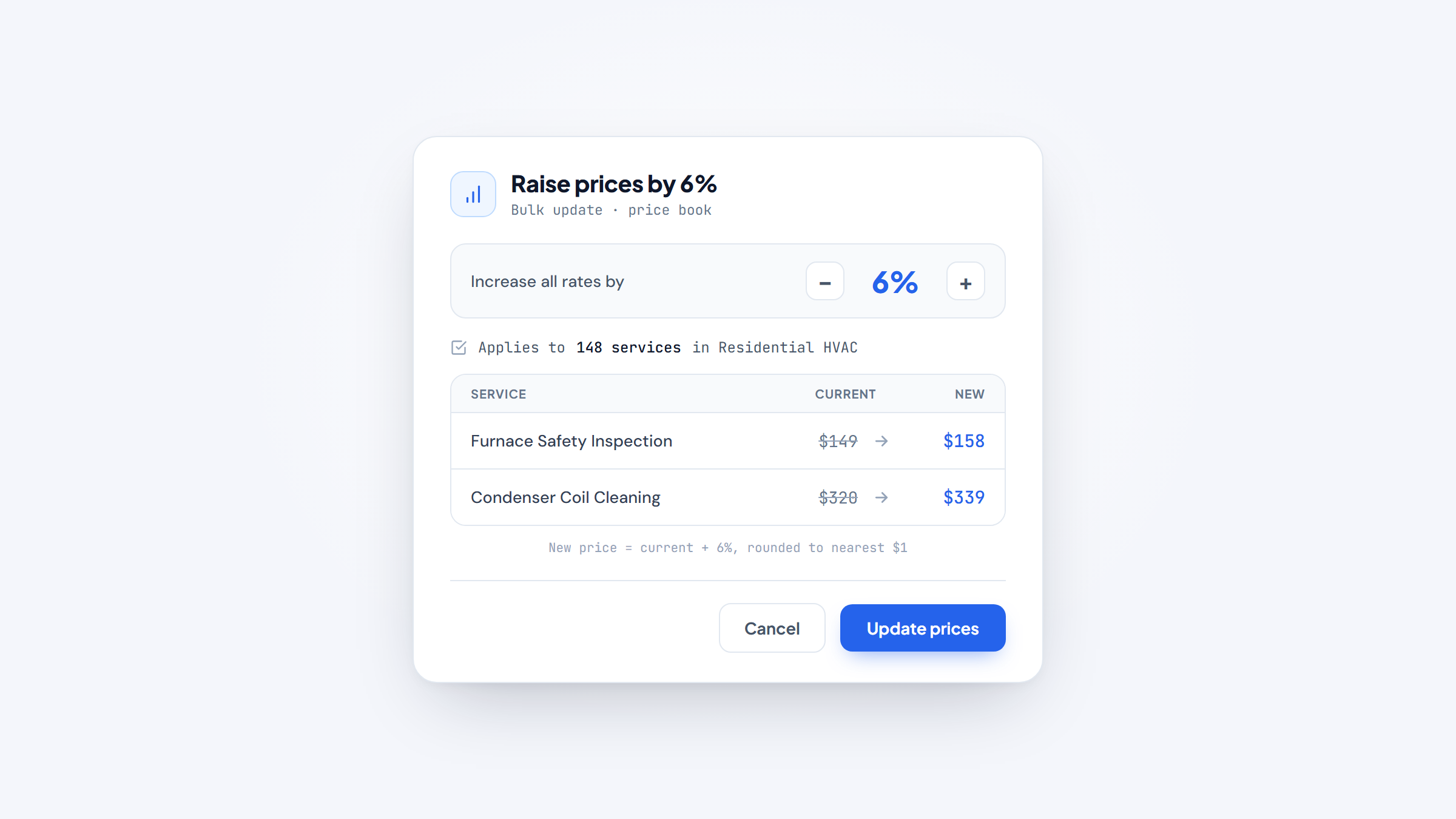
An HVAC pricing book, more precisely a flat-rate price book, is a catalogue of your common repairs with a finished price attached to each. The technician looks up "replace condenser fan motor," shows the customer a number, and the number is the same whether it is Tuesday or a holiday, and whether the tech is fast or slow.
Getting one is a build-or-buy decision.
- Build it yourself by listing your fifty most common repairs, timing each honestly, and running each through the cost-and-margin math above. It is a week of unglamorous work and it produces a book that matches your actual costs.
- Buy one from a price-book vendor, then adjust every line to your labor rate and overhead. Faster, and dangerous if you skip the adjusting, because a book priced for a different market will be wrong in yours.
Either way it is a living document. Review it at least annually, and revisit it whenever your labor rate, your insurance, or your equipment costs move. A price book that has not changed in three years is quietly losing you money on every line.
Presenting those prices cleanly, on the spot, is its own problem, and it is what proposal software for HVAC is built to solve.
Service Fees, Emergencies, and Memberships
Three prices sit around the job itself, and each gets set wrong routinely.
The service call or diagnostic fee commonly runs $70 to $200. That range is consistent across the trade, though it ultimately traces to consumer cost-aggregator sites rather than a contractor survey. Many shops credit the fee toward the repair if the customer proceeds. Decide whether yours does, and say so before you dispatch.
Emergency and after-hours work typically carries a 1.5x to 2x labor multiplier, or a 50% to 100% premium. This is not a penalty; it reflects paying a technician overtime to leave their family at 11 p.m. Price it to be worth doing, or stop offering it.
Membership and maintenance plan discounts are the trap. A 10% to 15% member discount on repairs is standard, and it must be built into your baseline pricing, not stacked on top of it. If your flat-rate book already prices at your target margin and you then take 15% off for members, you have just given away most of your service profit. Price the non-member rate to absorb the discount.
That interacts directly with how you sell agreements, which is covered in our guide to HVAC marketing.
Commercial HVAC Pricing Follows Different Rules
Any commercial HVAC pricing guide has to start by admitting that commercial work is not residential pricing with bigger numbers. The buyer, the cycle, and the margin structure all change.
Commercial service is more often billed time and materials, because the scope of a rooftop unit failure is genuinely unknown until someone is on the roof, and property managers are comfortable with hourly billing and job costing. Large projects are bid, with detailed cost tracking, and they run at the 3% to 5% net margins ACCA describes rather than service-department margins.
Maintenance contracts are where commercial contractors make their money, and they are structured by coverage tier rather than by a single rate: labor-only, labor plus parts, or full coverage including replacements. Most are billed per visit or per piece of equipment covered.
You will find articles quoting a price per square foot for commercial maintenance. The published figures disagree by a factor of seven or more, none come from an authoritative source, and buildings differ far too much for a single rate to mean anything. Do not price commercial maintenance per square foot. Count the equipment, estimate the labor hours per visit, apply the same cost-and-margin math, and quote from that.
Review Prices on a Schedule, Not a Feeling
Costs move every year. Wages rise, insurance renews higher, equipment gets tariffed, and your prices sit where you left them.
Review your labor rate and overhead allocation at least annually, and your price book every six to twelve months. Recalculate rather than adding a blanket percentage, because the components move at different speeds.
There is an old line among contractors, repeated in that same Reddit thread: if nobody ever complains about your prices, you are not charging enough. It is crude, and it points at something real. A price that never meets resistance is a price that left money on the table on every job you won, and you will never see the invoice for that.
Getting the Number Right
Fair pricing in HVAC is not about being the cheapest or the most expensive. It is about charging a number you can explain, line by line, from the wage on up.
Burden your labor. Divide by billable hours, not paid hours. Allocate overhead per hour. Divide by one minus your target margin, never multiply by the markup. Then check your result against ACCA's departmental targets and adjust the business, not the arithmetic, when the two disagree.
Do that and the rest of the business gets easier. Your close rate stops depending on being cheap, your average ticket reflects your real costs, and your marketing spend can be judged against a job whose profit you actually know.
That connection between price, close rate, and lead cost is worked through in our guides to generating HVAC leads and building an HVAC marketing plan. The pricing signals that pre-qualify callers before they ever dial are covered in our guide to HVAC SEO.
Frequently asked questions
HVAC flat rate pricing quotes one finished price for a repair before work starts, taken from a price book, rather than billing hours and parts afterward. The customer approves a known number, and efficient technicians become more profitable instead of less. It dominates residential service. ACCA's figures suggest flat-rate service departments run roughly five points of net margin above time-and-materials departments.

Still comparing HVAC software?
Filter 159 vetted tools by pricing, business size, and the features your shop actually needs. No signup, no sales calls.