HVAC SEO: How to Get More Calls From Search
A practical HVAC SEO guide: rank in the map pack, earn reviews, fix service-area pages, and track the calls that actually book work.
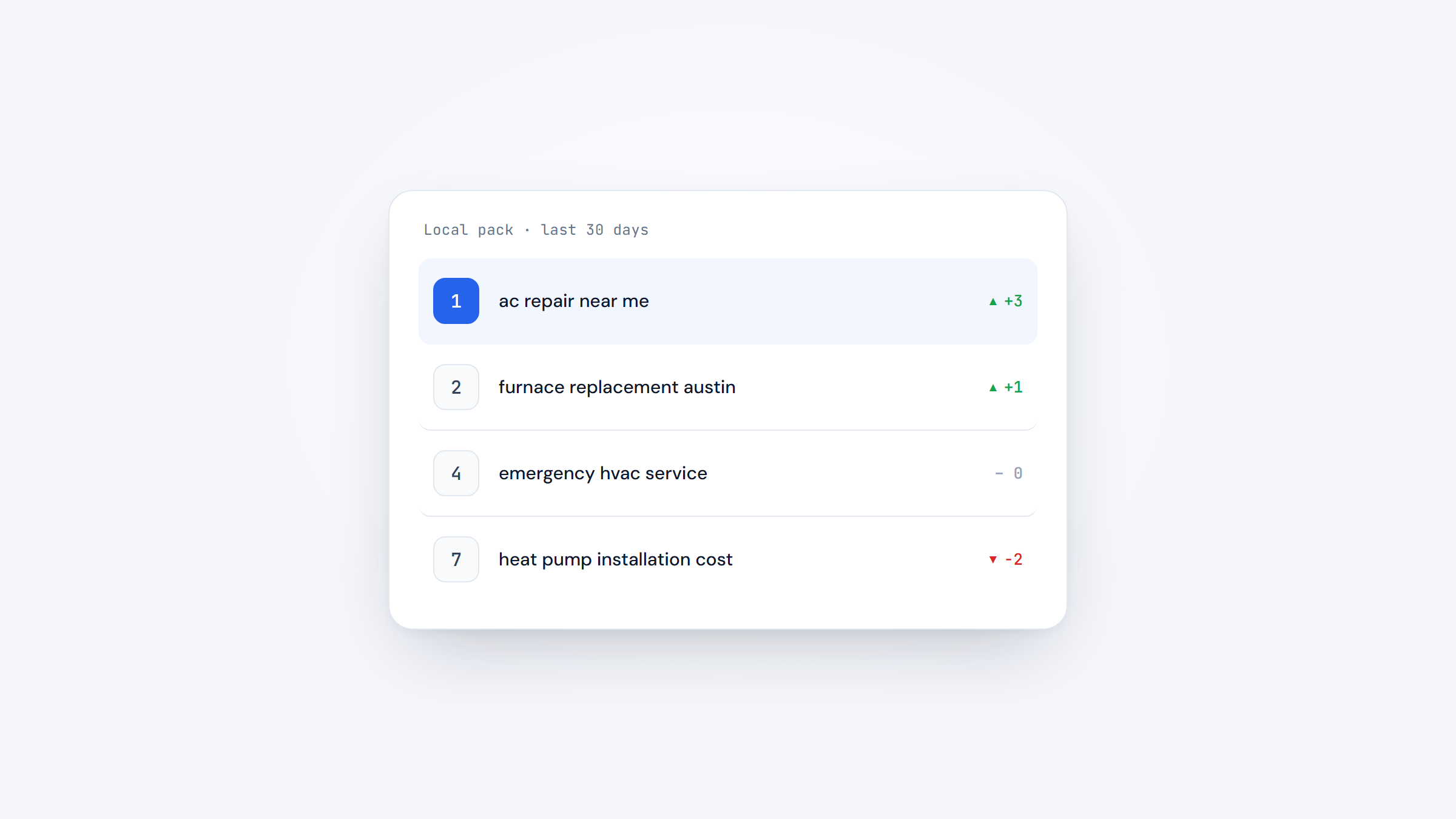
When a homeowner's AC dies in July, they pull out a phone and search. Whoever shows up in that moment gets the call, and everyone else waits for the next one. HVAC SEO is the work of being the company that shows up.
It is not mysterious, but it is specific. Ranking for "AC repair near me" in your town has almost nothing to do with the tricks that rank a national blog, and most of the advice written for HVAC contractors is either recycled or trying to sell you a retainer.
This guide covers what actually moves the needle: how Google decides who appears, how to set up your Google Business Profile, how to earn reviews without breaking the rules, how to build service pages that do not cannibalize each other, and how to track whether any of it is producing calls.
What HVAC SEO Actually Is
SEO for HVAC contractors is the practice of getting your business to appear when someone nearby searches for the work you do. Two different results are in play, and they behave differently.
The first is the map pack, the block of three businesses with a map above the regular results. It is driven almost entirely by your Google Business Profile and your proximity to the searcher. The second is organic results, the standard blue links below, driven by your website's pages, content, and links.
Most emergency HVAC searches are won in the map pack. Most research searches ("how long does a furnace last") are won organically. Local SEO for HVAC contractors means working both surfaces, because they feed different parts of your business, and a serious HVAC company SEO effort never picks just one.
Map pack | Organic results | |
|---|---|---|
What drives it | Google Business Profile, proximity, reviews | Website pages, content, links |
Wins which searches | "AC repair near me," emergency, high intent | Research questions, comparisons, planning |
Fastest to influence | Yes, days to weeks | No, typically months |
Where the calls are | Most of them | Fewer, but higher research intent |
Think of the map pack as the phone line and organic as the reputation that fills it. You want both, but if you only have time for one, start with the profile.
How Google Decides Which HVAC Company Shows Up
There is a lot of speculation about local rankings, and there is also an official answer. Google states that local results are based on three factors:
- Relevance. How well your profile matches what the person searched for. A profile that lists "furnace repair" as a service is more relevant to that search than one that only says "HVAC."
- Distance. How far your business is from the searcher. You cannot change this one, which is why a single location does not rank evenly across a whole metro.
- Prominence. How well known your business is, informed by things like links and review count.
Google is also explicit that you cannot pay for better local ranking. Any agency that implies otherwise is selling something.
The practical read: relevance and prominence are the two levers you actually control, and both are cheaper to move than most contractors assume. Distance explains why your competitor across town outranks you at their address and loses to you at yours.
Optimize Your Google Business Profile First
Nothing in HVAC SEO returns more for less effort than a complete, accurate Google Business Profile. Most contractors set one up, verify it, and never touch it again.
Work through the profile field by field, because Google uses these to judge relevance.
The Profile Checklist
Seven fields do most of the work, and none of them require a specialist.
- Use your real, registered business name. Do not stuff it with keywords ("Bob's HVAC | AC Repair Phoenix"). Google penalizes this, and it is one of the fastest ways to get a listing suspended.
- Set the right primary category, then add secondary categories. "HVAC contractor" is usually primary; add "air conditioning repair service," "furnace repair service," and "heating contractor" as they apply.
- List services as individual line items, not buried in the description. Each service you add is another thing Google can match a search against.
- Mark yourself as a service-area business if you work out of a home or a truck. This hides your street address while keeping you eligible to rank, and you still complete verification normally.
- Set accurate hours, including emergency hours. If you answer the phone at 11 p.m., say so.
- Add real photos of real jobs, not stock images. Refresh them quarterly. Techs on actual installs beat a logo every time.
- Use a local phone number, and make sure it matches the number on your website exactly.
None of this is glamorous, and all of it compounds. A profile with complete services, real photos, and honest hours simply matches more searches than one with a name and a phone number.
Get Reviews, and Keep Them Coming
Reviews feed prominence, and they also decide whether the person who found you actually calls. The numbers here are worth internalizing.
According to BrightLocal's 2026 survey of 1,002 US consumers, 97% read reviews for local businesses. 47% will not use a business with fewer than 20 reviews, and only 9% will consider one with five or fewer. Volume is a threshold you have to clear before anything else matters.
Recency matters at least as much. 74% of consumers only weigh reviews posted in the last three months, which means a company with 300 reviews and none since spring looks staler than one with 40 and a steady trickle. Consistent sentiment across reviews (56%) actually outranks the star rating alone (42%) in what people care about.
How to Actually Get Them
HVAC owners on Reddit converge on the same two moves, and both happen at the same moment.
- Ask at the door, right when the customer says something positive. That is the highest-conversion moment there is, and it disappears the second you drive away.
- Follow up the same day by text, with a one-tap link straight to your Google review page. Email barely gets opened; a text with a direct link does.
- Ask every satisfied customer the same way. Do not screen for likely five-star customers first.
- Never offer anything in exchange for a review. Google's own policy prohibits incentivized reviews, and the FTC's rule on consumer reviews targets fake and suppressed ones.
That fourth point is where well-meaning contractors get into trouble. "Review gating," asking only the customers you expect to be happy, crosses a line, and so does a discount for a five-star rating. Ask everyone, respond to every review you get, and let the average be what it is.
Build Service Pages That Do Not Cannibalize Each Other
Here is the most expensive mistake in HVAC SEO, and almost every contractor site has it. You want to rank in twelve towns, so you build twelve pages that are identical except for the town name.
It does not work the way you hope. One HVAC owner in Northern Virginia described the problem on Reddit: he had roughly 30 near-identical service-location pages and found one massively outranking the rest for the same target keyword. Other practitioners in the thread confirmed the pattern, roughly half of such pages pick up few or no clicks, and some never get indexed at all.
The fix is not "write unique content" in the abstract. It is layering genuinely different material onto each page.
- Area-specific FAQs, answering what people in that town actually ask (older housing stock, well water, HOA restrictions).
- Reviews pulled from your profile, filtered to customers in that service area.
- Named techs who actually cover that area, with a photo.
- A rotating block of local tips or current offers, so the page is not frozen.
The harder test is whether you genuinely serve the town. Google does not reward location pages for cities where you have no real presence, and neither do customers. Build pages for the areas you actually roll trucks to, and give each one a reason to exist.
Target the Keywords People Actually Type
Not every search is worth the same. A homeowner typing "AC not blowing cold air" is in a different place than one typing "emergency AC repair," and they need different pages.
Grouping searches by where the person is in their thinking keeps you from writing a blog post when you needed a service page.
Intent | What they type | What serves it |
|---|---|---|
Emergency | "emergency AC repair," "AC repair near me" | Service page, click-to-call, fast load |
Troubleshooting | "furnace blowing cold air," "AC leaking water" | Blog post that ends in a call option |
Planning | "how much does a heat pump cost," "furnace vs heat pump" | Guide, comparison, pricing signals |
Local shopping | "HVAC company in [town]" | Service-area page, reviews, profile |
Put pricing signals on the pages where people are planning. A range, a starting price, or a clear explanation of how you quote will keep more people on the page than hiding it, and it filters out the callers who were never going to book. How you arrive at those numbers is its own subject, covered in our HVAC pricing guide.
Fix the Technical Basics
Technical SEO for HVAC companies is mostly a short checklist, not an ongoing project. A contractor site is small; you can get this right once.
- Make it fast on a phone. Google publishes Core Web Vitals thresholds: Largest Contentful Paint under 2.5 seconds, Interaction to Next Paint under 200 milliseconds, Cumulative Layout Shift under 0.1. Run your site through PageSpeed Insights and fix what it flags, usually oversized images.
- Put the phone number above the fold, as a tap-to-call button on mobile. The person with a dead furnace is not scrolling.
- Add LocalBusiness schema to your homepage and Service schema to your service pages, so Google can read your address, hours, and services without guessing.
- Submit an XML sitemap in Google Search Console, and check the coverage report for pages that are not getting indexed. Those city pages you built are the first place to look.
- Use HTTPS, and make sure your business name, address, and phone number match exactly across your site, your profile, and every directory.
Get these done and stop touching them. Technical work has a floor, not a ceiling, and past a certain point more of it will not produce another call.
Earn Local Links and Citations
Prominence, the third of Google's factors, is partly about who mentions you. That splits into citations and links.
Citations are listings of your business name, address, and phone number on other sites. The ones worth claiming are Yelp, Angi, the Better Business Bureau, Bing Places, Apple Maps, Nextdoor, and your local chamber of commerce. Consistency is the whole point: the same name, the same address format, the same phone number everywhere.
Links are harder and worth more. The realistic sources for an HVAC contractor are local and unglamorous: sponsoring a youth team, co-hosting a home-safety event with the fire department, joining the chamber, supplier and manufacturer dealer directories, and being quoted in a local paper.
What does not work, and carries real risk, is buying links or paying for bulk directory submissions. That is a penalty waiting to happen, not a shortcut, and every credible source in this space says the same thing.
Track Calls, Not Just Rankings
A ranking is not a result. Plenty of HVAC companies rank well in a spot nobody searches from, and plenty rank poorly on paper while the phone rings all day.
Two kinds of tracking are worth setting up.
- Call tracking. Tools like CallRail or WhatConverts assign a tracking number to each channel so you know whether a call came from your profile, an ad, or organic search. Without this you are guessing at what works.
- Grid rank tracking. A single "position 4" is meaningless in local search, because you rank differently at every point on the map. Tools like Local Falcon or Local Viking show your ranking across a grid of your service area, which is what actually reflects reality.
Then log what happens after the call. A lead that never books is not a win, and knowing your booking rate by channel is what turns SEO from a cost into a number. Search is only one of several ways to generate HVAC leads, and the only fair way to compare them is on booked jobs, not raw call volume.
If you are building that measurement into a broader system, a CRM for HVAC is usually where the call, the job, and the revenue finally get tied together.
Mistakes That Stall HVAC SEO
Most stalled HVAC SEO is not missing a clever tactic. It is doing one of these.
- Keyword-stuffing the business name on your profile. Fastest route to a suspension.
- Duplicate city pages. Covered above, and worth repeating because it is nearly universal.
- Buying links or bulk directory packages. Risk without reward.
- Publishing thin content on a schedule because someone said to blog weekly. Mass-produced pages do not rank and dilute the ones that could.
- Chasing broad rankings that do not convert. Ranking for "HVAC" nationally is worth nothing to a company with four trucks.
- Never asking for reviews, then wondering why a competitor with 200 outranks you.
The pattern is that each of these substitutes volume for relevance. Google, for its own reasons, has spent a decade getting better at telling the difference.
DIY or Hiring HVAC SEO Experts
You can do most of this yourself. The profile, the reviews, the citations, and the basic technical fixes are a matter of hours, not expertise, and they account for the majority of the result for a small contractor.
Where HVAC SEO experts genuinely earn their fee is in competitive metros, at multi-location scale, or when you want content and links produced steadily and do not have anyone to do it. Agencies commonly quote somewhere in the range of $1,500 to $5,000 a month for HVAC contractor SEO, though those figures come from the agencies themselves rather than any independent survey, so treat them as a starting point for negotiation.
Whoever does it, expect months rather than weeks. Practitioners across this field generally report three to six months before organic work shows up in the numbers, while profile and review work can move within weeks. Anyone promising page one by next month is either misinformed or selling.
Where to Start This Week
If you do nothing else, do these in order: complete every field on your Google Business Profile, start asking every satisfied customer for a review at the door, and audit your service-area pages for the city-swap problem. Those three account for most of the gap between contractors who get calls from search and those who do not.
Then measure. Put call tracking on, learn which channel actually books work, and let that decide where the next dollar goes. SEO is one channel among several, and it works best inside a plan that accounts for the others, which is the subject of our guides on HVAC marketing and building an HVAC marketing plan. Search will not fill your calendar by itself, but done properly it is the cheapest lead you will ever get.
Frequently asked questions
HVAC SEO is the work of getting your company to appear when nearby homeowners search for heating and cooling services. It covers your Google Business Profile and map-pack visibility, your website's service and service-area pages, reviews, local citations and links, and the technical basics like mobile speed. The goal is not rankings for their own sake, it is calls from people who need work done now.

Still comparing HVAC software?
Filter 159 vetted tools by pricing, business size, and the features your shop actually needs. No signup, no sales calls.