Effective HVAC Advertising Tips for Small Businesses in 2026
Effective HVAC advertising on a small budget: how to run Local Services Ads, Google Ads, and Facebook ads that book jobs, with real 2026 cost benchmarks.
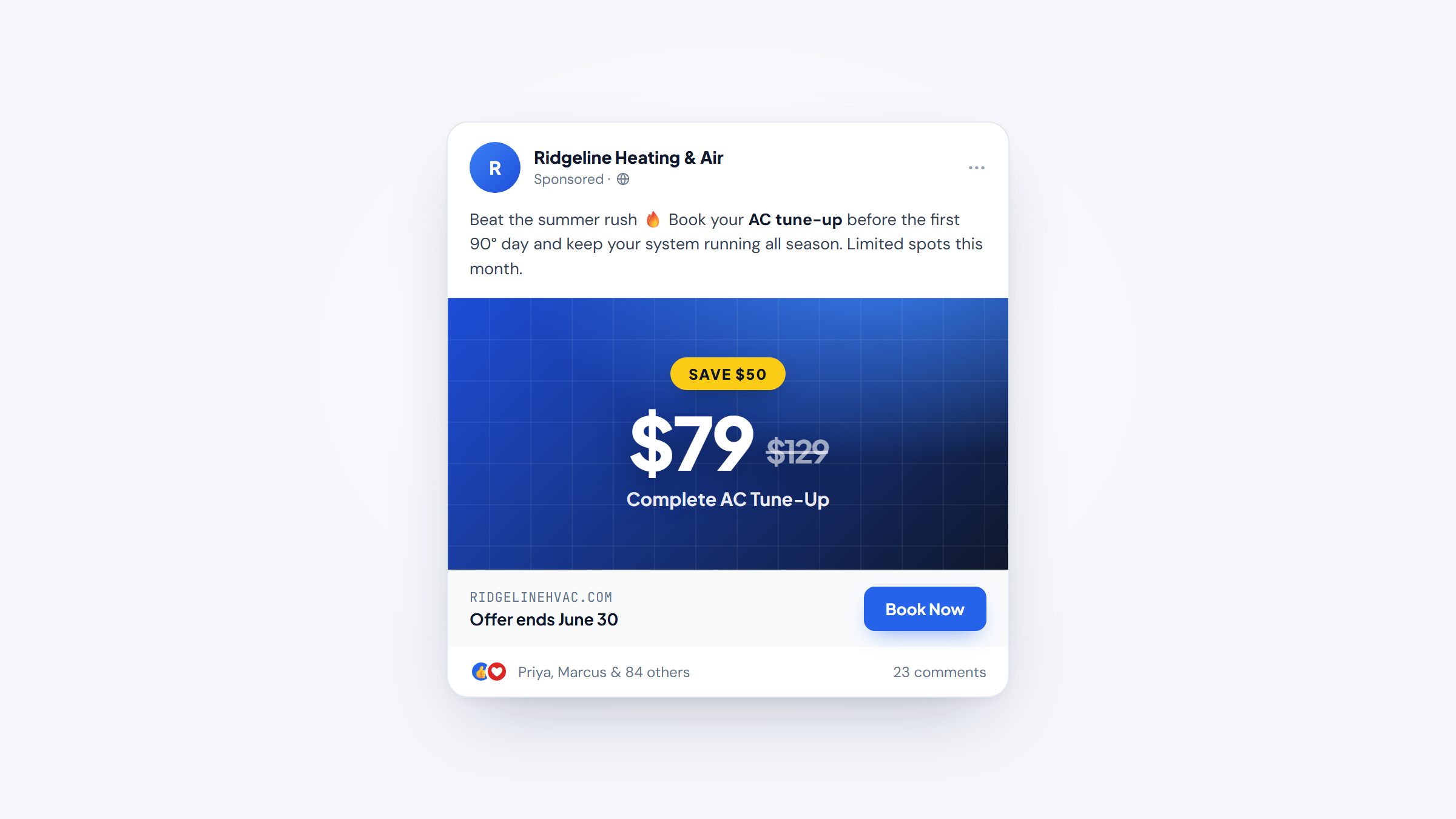
Most small HVAC shops waste money on ads for the same reason: a generic message on the wrong channel, judged by the wrong number. They boost a Facebook post about "quality service," send every click to the homepage, count the likes, and conclude that ads don't work.
Ads work fine. The problem is matching the channel to the buyer's intent and writing something specific enough to earn a call. This guide stays in the execution lane: which paid channels to run, how to set each one up, the ad copy that books jobs, and what a lead actually costs in 2026.
What Makes HVAC Advertising Effective in 2026
Effective advertising starts with a blunt question: is this ad meeting demand that already exists, or trying to create it? The answer decides everything else, from the channel to the copy to the offer.
Two intents dominate this trade. Emergency intent is the homeowner searching "AC repair near me" in a hot house, ready to book the first shop that answers. Planned intent is the family weighing a replacement for a 15-year-old furnace before winter, comparing options over a few weeks.
You reach the first with Google, the second with social and retargeting. Get that split wrong and even a well-written ad underperforms, because it's landing in front of the wrong buyer.
Paid ads also aren't a substitute for the rest of your HVAC marketing. They're the fast lever you pull when you need booked jobs this week, while reviews, referrals, and organic search build slower underneath.
The channels below assume you already have the basics: a business profile with reviews, a phone that gets answered, and a way to track where each call came from. If your booking process leaks, spending more on ads just buys more missed calls.
Start With Google Local Services Ads
For most HVAC contractors, Local Services Ads (LSA) are the cheapest, highest-return paid channel available, and the right place to start. They sit at the very top of Google's results, above the regular search ads, and they work differently from the rest.
You don't pay per click. You pay per lead, meaning an actual phone call or message from a homeowner in your area. Google sets each lead's price and you set a weekly budget cap, so you never overspend.
Vendor data from SearchLight Digital (self-reported, not audited) pegs HVAC LSA at roughly $51 per lead with a 44% book rate and a $2,110 average ticket across 888 contractors in early 2026, making it about 49% cheaper than blended Google Ads and 64% cheaper than non-branded search.
The Google Verified Badge, Explained
Here's a fact almost every competitor's guide still gets wrong: the old "Google Guaranteed" badge is gone. As of October 20, 2025, Google renamed it to a single "Google Verified" badge and discontinued the money-back guarantee that used to back it, per the Google Local Services Help documentation.
The badge still signals that Google screened your license and insurance, but there's no longer a Google-funded refund promise to point customers to. If your website or scripts still promise a "Google Guarantee," fix that copy now.
Reviews Come First
Reviews are the top ranking factor for LSA, and they're also what makes a homeowner tap your listing over the shop below you. Don't scale LSA spend until you have at least 15 Google reviews, or you'll pay for leads you don't win because a competitor with 200 reviews looks safer.
According to BrightLocal, 97% of consumers read reviews for local businesses, and the average shopper checks around six review sites before deciding. Your star rating isn't vanity; it's the deciding factor for a stranger about to let a tech into their home.
Before you scale LSA, run through this launch checklist so you're not paying for leads you can't convert:
- Collect at least 15 Google reviews before you raise your weekly budget.
- Enable each service category separately (AC repair, furnace repair, install), not one blended listing.
- Set the bid mode to Maximize Leads and a weekly cap you can comfortably afford.
- Answer emergency leads within 15 minutes, which books 40 to 60% of them.
- Dispute junk leads (wrong area, spam, out of scope) so Google credits them back.
- Review your book rate and disqualified-lead reasons weekly, not just cost per lead.
Segmenting by specific service category instead of one catch-all listing tends to cut cost per lead by roughly 15 to 25%, because Google matches each request to a real service you offer.
Run Google Search Ads by Service Line
Local Services Ads catch high-intent local searches, but they can't cover everything. Google Search ads (the classic text ads below the LSA block) let you target exact phrases and control the landing page, which is where HVAC PPC advertising earns or wastes its budget.
The single biggest mistake here is running one campaign for "HVAC." That bucket mixes a $198-per-lead generic searcher with a $144-per-lead heating-repair searcher and an $86-per-lead AC-maintenance searcher (SearchLight non-branded figures, vendor data). Blend them and you overpay for the vague clicks and can't tell what's working.
Segment Every Campaign
Build a separate campaign or ad group for each service line: AC repair, furnace repair, installs, maintenance plans. That way you see the true cost per booked job for each and shift budget toward the ones that close.
Independent data backs the caution on generic terms. LocalIQ's 2025 home services benchmarks, built from 3,211 US campaigns run between April 2024 and March 2025, show HVAC clicks and leads landing well above many trades.
Service line | Avg CTR | Avg CPC | Avg CPL |
|---|---|---|---|
Air Conditioning Install & Repair | 6.43% | $9.68 | $127.74 |
Heating & Furnaces | 5.97% | $9.30 | $129.02 |
Home services (all categories) | 6.37% | $7.85 | $90.92 |
Those are national averages, and your metro may run higher, which we'll cover in the budgeting section. Treat them as a sanity check: if you're paying $300 a lead on AC repair, something in your targeting, copy, or landing page is broken.
Bid on Your Own Name
Spend 5 to 10% of your search budget on branded search, meaning your own company name. It feels redundant, but the math is one-sided. Vendor data puts branded HVAC leads around $34 each with a 55% book rate, versus $149 and a 38% book rate on non-branded terms. People searching your name already trust you, so don't let a competitor bid on it and steal the click.
Send Clicks to a Matching Page
Never send a search ad to your homepage. A "furnace repair" ad should land on a furnace-repair page with a headline, offer, and phone number that match the search. The homepage makes the visitor hunt for what they wanted, and every extra click bleeds conversions.
Facebook and Instagram Ads for HVAC
Social ads are the second half of the picture, and the part most contractors run backward. Facebook and Instagram are excellent at seasonal, replacement, and retargeting demand. They're poor at catching the homeowner whose AC just died, because that person is on Google, not scrolling. Use HVAC social media advertising to plant the seed and stay top of mind, not to chase emergencies.
The cost profile explains the fit. LocalIQ's September 2025 Facebook data shows Home and Home Improvement advertisers paying about $0.99 per click on a traffic objective and $2.23 per click on a leads objective, with a $41.26 cost per lead and a 5.22% conversion rate on lead campaigns.
That $41.26 looks cheaper than a Google lead, but it isn't apples to apples: a Facebook lead is a colder, earlier-stage contact, while a Google lead is often someone ready to book today.
One note on numbers you'll see elsewhere. Vendor blogs love to cite "$0.50 to $2" Facebook CPCs, but that's a traffic-objective click, not a qualified lead. When you optimize for leads, expect the $2.23 range, and judge it by booked jobs.
Start Seasonal Campaigns Early
Timing is the whole game on social. Launch your cooling campaigns three to four weeks before the season actually turns. By the time everyone's AC is failing in June, every shop in town is bidding and your CPC spikes. Get in front of homeowners in the shoulder season, when clicks are cheap and you're one of the few talking tune-ups.
Build a Three-Tier Funnel
Don't ask a stranger to book a $6,000 system on the first ad. Warm them up across three stages, moving each group closer to a call:
- Run cold-audience awareness ads to homeowners in your service area, led by a family-comfort image rather than a photo of equipment.
- Retarget video viewers and page visitors with a specific seasonal offer and an on-platform lead form that grabs name, phone, and zip.
- Hit warm leads and past customers with urgency, like "limited $59 tune-up slots this week."
Lead with comfort, not compressors: a photo of a comfortable family at home beats a condenser unit almost every time, because the homeowner is buying a comfortable house, not a piece of metal.
Watch the Scam-Polluted Space
One real-world caveat from contractors themselves: Facebook's HVAC ad space is crowded with junk. A commenter on r/sweatystartup warned that Meta is a "hot-spot for HVAC scams," which is anecdotal but rings true. The takeaway: professional creative and clear branding matter more on Facebook than on Google, because cheap, generic creative gets lumped in with the scams next to it.
Write Ads That Actually Book Jobs
Channel choice gets you in front of the right person; the ad copy decides whether they call. Most HVAC ads fail here, drowning a real offer in warm, vague phrases that every competitor also uses. The fix is specificity: a number, a guarantee, or a concrete outcome beats a feeling every time.
The Emergency Ad Formula
For urgent, high-intent searches, structure the ad around the panic the searcher feels. Here's a reliable pattern:
The headline leads with the pain and the fix: "AC Out? Same-Day Repair in [City]." The second line stacks credibility: "Licensed and Insured | 500+ 5-Star Reviews." A third line makes a commitment: "1-Hour Response Guarantee." The description reassures on price and availability: "Certified techs on call 24/7. Clear price before we start." The call to action is a verb, not a shrug: "Call Now" or "Book Online."
Never run "Learn More" on an emergency ad. Someone with a dead AC doesn't want to learn; they want a tech at the door.
Weak Versus Strong, Side by Side
The gap between a wasted ad and a working one is usually one edit: replacing a warm generality with a concrete detail. Here's the same ad space, done two ways.
Weak (vague, interchangeable) | Strong (specific, bookable) |
|---|---|
"Contact us for all your HVAC needs" | "AC tune-up for $79 before June 1st" |
"Serving the area 20+ years" | "0% financing on full system replacements this month" |
"Call for a free quote" | "Clear flat price before we start, no surprises" |
"Quality service you can trust" | "1-hour response or your diagnostic is free" |
Every strong version names something the reader can act on: a price, a date, a guarantee. The weak versions could belong to any shop in any city, which is why they get scrolled past. When you write creative HVAC ads, force a specific into every line.
Slogans and Creative That Break the Sameness
Slogans are where HVAC advertising goes to sound identical. Walk any market and you'll see the same interchangeable filler: "Better air, better life," "Home comfort you can count on," "Trusted. Local. Family-owned." They're not wrong, just invisible, because the shop across town runs the same words.
Trade the warm generality for a number, a guarantee, or a concrete promise. "Family-owned since 1998, and we'll text you a photo of the tech before he arrives" says something that "home comfort you can count on" never will.
HVAC Advertising Examples Worth Copying
The shops that stand out break the wall of sameness instead of polishing the same message. A couple of real HVAC advertising examples show the range.
One company, NexGen Air, ran a "Spotify Wrapped"-style Instagram carousel that recapped the year's HVAC tips in a familiar, shareable format, borrowing a cultural moment homeowners already recognize.
Another shop posted a Facebook video that literally destroyed a customer's dead AC unit, captioned with a simple "we'll take care of it." It's funny, human, and it makes the point that they handle the ugly part. Neither ad reads like the generic HVAC contractor advertising everyone else runs, which is exactly why they get shared.
Whatever angle you pick, keep it consistent across every channel: the same logo, colors, offer, and voice on your LSA listing, your search landing pages, and your social creative. That is what makes a homeowner who saw your Facebook video recognize your name on Google.
Seasonal Offers That Fill the Schedule
The right offer turns an ad from a message into a booking. For HVAC, seasonal offers do the heavy lifting, because demand swings hard between shoulder season and peak, and your pricing should swing with it.
Raise the Tune-Up Price as Peak Nears
A reusable tactic: price a tune-up low early and raise it as the season heats up. Run $59 as an early-bird special in March, $79 in April, $99 in May, and $119 once you're in-season. Early homeowners get a real deal, you fill the slow calendar, and the rising price creates honest urgency because waiting genuinely costs more.
For bigger jobs, an "up to $2,500 trade-in allowance" on a system replacement gives your comfort advisor room to flex by job size instead of quoting one flat discount. It sounds substantial and stays profitable because it's a ceiling, not a giveaway.
Don't Play Games With the Diagnostic Fee
One rule that protects your reputation: never waive a diagnostic fee up front and then quietly fold it back into the repair price. Homeowners notice, they compare notes, and it reads as a bait-and-switch. If you offer a free or discounted diagnostic, honor it as a real discount.
Getting the discount math right depends on knowing your true costs, which is a pricing exercise, not a marketing one. Work the numbers with a proper pricing guide so your $79 tune-up still leaves margin after the tech's time, the truck, and overhead. An offer that loses money on every job is a slow way to go broke.
Budget Your Ad Spend Without Guessing
The most common budgeting question is "what should a lead cost?" It depends on your metro, service line, and channel, but you can anchor to real numbers instead of guessing.
Nationally, HVAC search leads run roughly $90 to $150 depending on the service line, per the LocalIQ data above, and vendor figures from SearchLight put blended Google Ads at about $104 per lead and LSA far lower. Those give you a baseline to judge your own account against.
Your Metro May Run Higher
National averages hide big local swings, and competitive metros run well above them. An operator running ads for Las Vegas HVAC and plumbing shops shared on r/smallbusiness that qualified HVAC leads cost him around $200 each, versus about $100 for plumbing.
That's anecdotal and market-specific, but it's a useful reality check: if you're in a dense, competitive city, budget above the national $90 to $150 range and don't panic when your CPL lands there.
Put It in a Written Plan
Budget per service line, because the acceptable cost per lead is different for a maintenance call and a full-system replacement, then fold the whole thing into a written plan rather than month-to-month guesswork.
A simple marketing plan that sets a monthly ad budget, splits it across LSA, search, and social, and reviews the numbers each month keeps you from overspending in a panic during peak season and going dark when it's slow.
Track Book Rate, Not Just Cost Per Lead
Cost per lead is the number everyone watches and the wrong one to optimize alone. A channel with a $40 lead that never books is worse than a $120 lead that turns into a $6,000 install. What matters is cost per booked job, and the book rate behind it.
Book rate is the share of leads that turn into scheduled work, and vendor data shows how far it swings: branded search books around 55%, non-branded around 38%, and HVAC LSA around 44%. A cheap lead source with a low book rate can quietly cost you more per actual job than an expensive one that closes.
Review the Right Numbers Weekly
Once a week, sit down with more than the CPL. Track the handful of numbers that actually tell you which ads are paying off:
- Book rate by channel, so you see which source turns leads into scheduled jobs.
- Cost per booked job, not just cost per lead.
- Disqualified-lead reasons, grouped so you can spot a repeating pattern.
- Response time on inbound calls and messages.
- Which landing page or ad each booked job came from.
Disqualified-lead reasons are the underrated one. If half your LSA leads are outside your service area, tighten the radius. If they're the wrong service, fix your categories. You can only correct what you're logging.
Get the Tracking Plumbing Right
None of this works without call tracking. Use a unique tracking number per channel so you know whether a call came from LSA, search, or Facebook, and record each outcome (booked, quoted, junk) in whatever CRM or field-service tool your team already uses, so you're measuring revenue, not clicks. Advertising you can't trace back to booked jobs is just spending with extra steps.
Comparing the Three Paid Channels
Put the three channels side by side and the strategy gets obvious. Each owns a different slice of buyer intent, and a small HVAC shop usually wants all three running in proportion, with LSA taking the largest share. Here's how they compare on cost and best-fit intent, blending the independent LocalIQ benchmarks with vendor-reported HVAC figures where noted.
Channel | What you pay for | Typical HVAC cost | Best-fit intent |
|---|---|---|---|
Google Local Services Ads | Per qualified lead (call or message) | ~$51 CPL, 44% book rate (vendor data) | Emergency and high-intent local searches |
Google Search Ads | Per click | $9.30–$9.68 CPC, ~$104 blended CPL | Active "fix my AC now" searches |
Facebook / Instagram | Per click or per lead form | $2.23 CPC, $41.26 CPL on lead objective | Seasonal, replacement, and retargeting |
Read that table by intent, not just by price. Facebook's $41 lead is the cheapest on paper but the coldest, LSA's $51 lead is the highest-return because it books nearly half the time, and search sits in between with the control to target exact service lines. Weight your budget toward LSA first, layer search on your profitable service lines, and use social for the seasonal gaps.
Pair paid ads with organic reach so you're not renting every lead forever. Steady work on HVAC SEO lowers your blended cost over time, because the calls that come from ranking well are free once you've earned them.
Ads Fill the Schedule, People Fill the Trucks
There's a failure mode worth naming: your ads work too well and you can't staff the demand. A calendar full of installs means nothing without techs to run them, and a rushed, understaffed job earns the one-star review that undoes your ad spend.
Advertising and hiring move together, so if you're scaling paid ads into a busy season, line up the crew first. Know what competitive HVAC salary looks like in your market so your offer attracts real talent, and sharpen your interview questions so the techs you hire can deliver the same-day service your ads promise.
Effective HVAC advertising in 2026 isn't a bigger budget or a cleverer slogan. It's matching the channel to the buyer's intent, writing something specific enough to earn a call, and measuring the one number that pays your bills: cost per booked job.
Start with Local Services Ads, segment your search campaigns by service line, use social for the seasonal build-up, and put a concrete offer in every ad. Do that, and your ad spend books jobs instead of buying likes.
Frequently asked questions
Set it by cost per booked job, not a flat monthly figure. National HVAC search leads run roughly $90 to $150, and vendor data puts Local Services Ads far lower, near $51. Work backward from what a job is worth: if an install nets $2,000 and closes on five leads, $150 leads are still profitable. Budget per service line, since a tune-up and a full replacement justify very different spend, and revisit the number each month.

Still comparing HVAC software?
Filter 159 vetted tools by pricing, business size, and the features your shop actually needs. No signup, no sales calls.