Top 10 FieldAware Competitors to Consider for HVAC Software in 2026
Compare 10 FieldAware competitors for HVAC in 2026. FieldAware has no HVAC vertical, so see the trade-built tools with verified pricing instead.
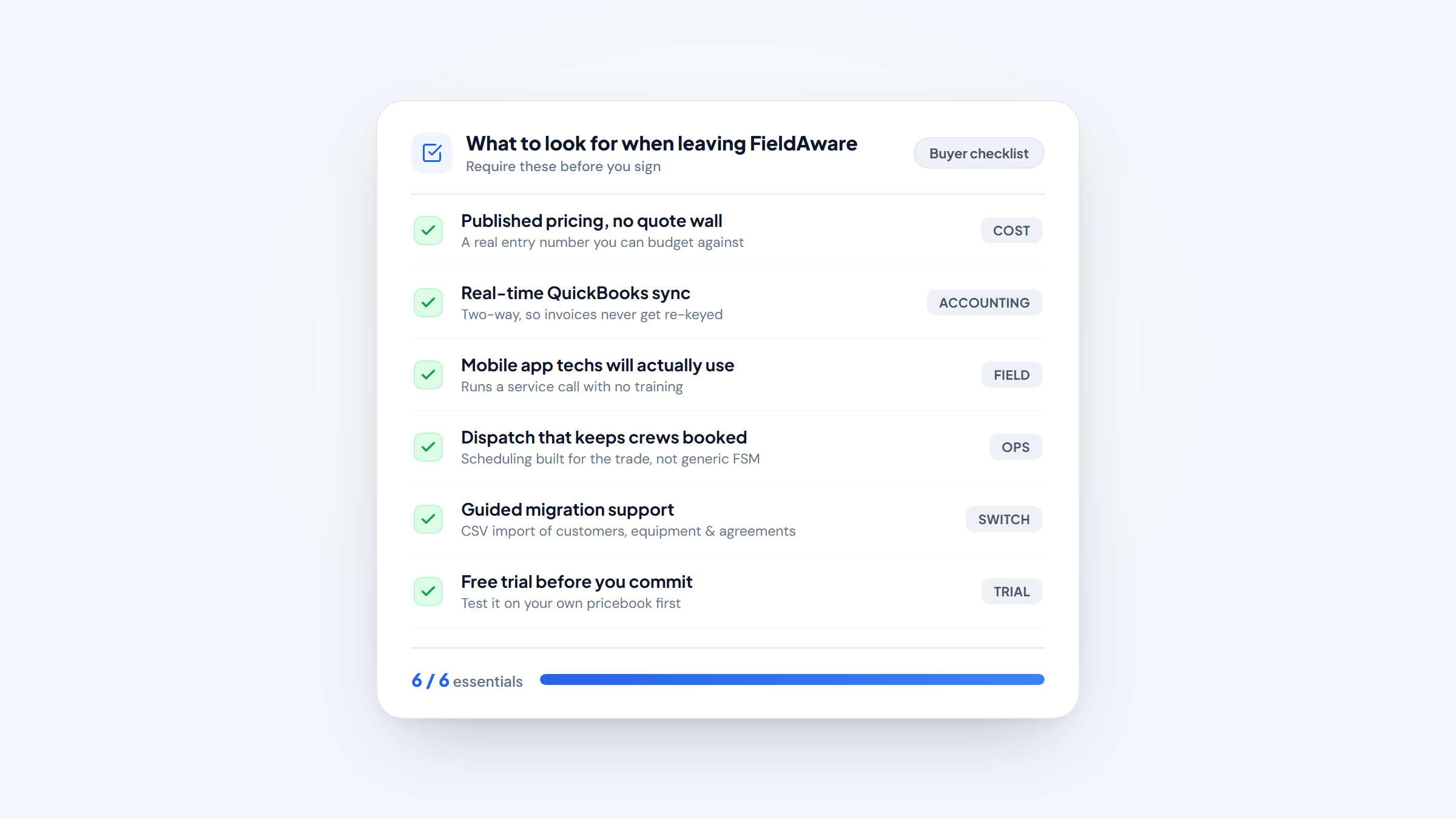
If you run an HVAC shop and you're shopping FieldAware competitors, the first thing worth knowing is that FieldAware is now branded FieldAware by GPS Insight, after GPS Insight acquired it. It's a capable field service management platform, but it was built for broad industrial and commercial work, not for heating and cooling contractors.
FieldAware's own site sells to Building and Construction, Facility and Property Management, Industrial Equipment, Commercial Equipment, Health Sciences and MedTech, and Oil and Gas. There's no HVAC vertical anywhere in that list. That's the spine of this whole comparison: FieldAware competes as generic industrial FSM, so an HVAC contractor is usually better served by a tool built for the trade or for commercial mechanical work.
This piece walks through 10 alternatives to FieldAware for HVAC, what each one costs, who it fits, and where it falls short. Every one of these competitors to FieldAware is a real, HVAC-relevant tool you can pick on merit instead of marketing.
Why Look for FieldAware Alternatives?
FieldAware isn't a bad platform. It just wasn't designed around how an HVAC business actually runs, and that shows up in a few concrete ways.
The biggest one is fit. A tool aimed at oil and gas or medical equipment servicing doesn't ship with the things HVAC contractors lean on daily: flat-rate pricebooks, maintenance agreement tracking tuned to seasonal tune-ups, or a mobile app your techs can run a residential service call from without training. You end up bending the software to the trade instead of the other way around.
Pricing is the second reason people look elsewhere. FieldAware is fully quote-based, its public pricing page 404s, and demo requests route to GPS Insight's forms. You can't compare it against anything without booking a call, which makes budgeting hard for a small or mid-size shop.
There's also the labor angle. The Bureau of Labor Statistics counted 425,200 HVAC mechanic and installer jobs in 2024 and projects 8 percent growth through 2034, much faster than average, with about 40,100 openings a year. With techs that hard to hire, dispatch and scheduling software that keeps your existing crew booked tight isn't a nice-to-have, so the tool you pick has to nail the basics for the trade.
Finally, ownership changes make some buyers nervous. Acquired products can see roadmaps shift and support move, and contractors who want a vendor squarely focused on field service worth their money often prefer a company whose whole business is that.
The Best FieldAware Competitors for HVAC
The 10 tools below split into three camps: commercial and mechanical platforms that go head to head with FieldAware's industrial roots, HVAC-native residential tools, and lean options for small crews. The table gives you the shape of each at a glance, then the entries go deeper.
Tool | Best for | Key features | Main limitation | Pricing (from) | Rating |
|---|---|---|---|---|---|
ServiceTitan | High-volume residential and commercial | Dispatch, pricebook, reporting | Enterprise pricing and learning curve | Custom | ★★★★½ |
BuildOps | Commercial mechanical at scale | Projects, PM, service | Overkill for small residential shops | Custom | ★★★★½ |
Simpro | Commercial jobs and maintenance | Project costing, add-on modules | Modules priced a la carte | Custom | ★★★★ |
FieldEdge | QuickBooks-heavy service shops | Real-time QuickBooks sync, agreements | Quote-only, dated interface | Custom | ★★★★ |
FieldPulse | Small and mid-size teams | CRM, estimates, AI dispatch | Pricing not public | Custom | ★★★★½ |
Commusoft | Commercial maintenance contracts | Asset tracking, planned jobs | Blocks sub-6-staff shops | Custom | ★★★★ |
Service Fusion | Shops wanting unlimited users | Flat-rate seats, dispatch | Add-ons cost extra | $208/mo | ★★★★ |
Housecall Pro | Growing residential contractors | Booking, payments, marketing | Thin on commercial jobs | $59/mo | ★★★★½ |
Workiz | Dispatch-first phone shops | Built-in phone, scheduling | Now quote-based | Custom | ★★★★½ |
Jobber | Owner-operators and small teams | Quoting, scheduling, invoicing | Light for commercial work | $29/mo | ★★★★½ |
Ratings reflect broad contractor sentiment and each tool's fit for HVAC specifically, not a single review site. Read the entries for the detail behind each score.
ServiceTitan

Best for: High-volume residential and commercial shops.
Where FieldAware treats HVAC as one industrial vertical among six, ServiceTitan was built around residential and commercial trades from day one. It's the platform contractors graduate to when they outgrow a lighter tool and want reporting deep enough to run a multi-truck operation.
That depth is the trade-off. It's the heaviest system here to learn and run, and it's priced for shops that have the volume to justify it.
Key features:
- Capacity-based dispatch that fills your board so techs aren't idling between calls.
- A built-in pricebook that pushes flat-rate options in front of techs at the door to lift ticket averages.
- Reporting that ties marketing spend to booked revenue so you know which campaigns pay.
Pricing: Fully custom and quoted per technician across its Starter, Essentials, and The Works packages, with no published rate. A widely cited figure of $3,500 to $4,000 a month for 10 techs is a third-party contractor estimate, not a ServiceTitan number, so treat it as a ballpark only.
Pros: Deepest reporting here, strong for both residential and commercial, mature integrations. Cons: Steep learning curve, priced for scale, quote-only.
Why it's a good FieldAware competitor: ServiceTitan gives you the enterprise horsepower FieldAware offers but tuned to HVAC work instead of generic industrial servicing. It's the natural landing spot for a growing shop that wants one system to run everything.
Final verdict: ServiceTitan fits high-volume shops with the budget to match, and our roundup of ServiceTitan alternatives covers cheaper paths if it's more than you need.
BuildOps

Best for: Commercial mechanical contractors at scale.
BuildOps is the entry that competes most directly with FieldAware's industrial angle, except it's aimed squarely at commercial HVAC and mechanical work. If your business is service plus projects plus preventive maintenance on large buildings, this is built for that shape of work.
It's a poor match for a small residential shop, and pricing is discovery-call territory. But for commercial mechanical, few tools go deeper.
Key features:
- Project management that tracks labor and materials against the estimate so big jobs don't quietly lose money.
- Preventive maintenance scheduling that keeps recurring service agreements on the board automatically.
- A tech app that handles work orders, timesheets, and photos in one place to cut paperwork after the call.
Pricing: Custom and quote-based, described as pricing for commercial contractors, with cost set by crew size, trades, and modules. You move through a discovery call to a demo to a proposal, so there's no self-serve number to compare.
Pros: Purpose-built for commercial mechanical, strong project and PM handling, modern interface. Cons: Overkill for small residential shops, quote-only, longer sales process.
Why it's a good FieldAware competitor: BuildOps takes FieldAware's commercial ambitions and focuses them on HVAC and mechanical instead of spreading across six industries. Contractors leaving FieldAware for a more specialized commercial platform tend to land here.
Final verdict: For commercial mechanical contractors managing service and projects together, BuildOps is one of the sharpest FieldAware alternatives on this list.
Simpro

Best for: Commercial jobs and maintenance contracts.
Simpro sits in the same commercial and mechanical lane as FieldAware, and it's built to handle both quoted project work and recurring maintenance. It scales from a five-person team to a couple hundred staff, so it grows with a shop that's taking on bigger contracts.
The catch is the pricing model. You buy a base plan and then bolt on the modules you need, which keeps entry cost lower but makes the total harder to pin down.
Key features:
- Job costing that runs from quote through to invoice so you see margin on every project.
- A maintenance planner that schedules recurring service and keeps asset history in one record.
- Add-on modules like GPS tracking and digital forms so you only pay for what your work actually needs.
Pricing: Quote-based, built on a single base plan plus a la carte add-ons such as digital forms, a maintenance planner, and GPS. There's no public dollar figure, and vendor productivity claims are marketing, so budget from a real quote.
Pros: Strong for commercial project work, scales to large teams, flexible module setup. Cons: Add-ons priced separately, quote-only, heavier than residential shops need.
Why it's a good FieldAware alternative: Simpro matches FieldAware's commercial reach while staying closer to the estimating and maintenance work HVAC contractors actually do. It's a solid fit for a shop that lives on quoted jobs.
Final verdict: Simpro rewards commercial contractors who want deep job costing and don't mind assembling their feature set from modules.
FieldEdge

Best for: QuickBooks-heavy HVAC service shops.
FieldEdge has been in the HVAC and plumbing space for years, and its signature is a real-time two-way QuickBooks sync that keeps your books and your field work in step. If double-entry into QuickBooks is your daily headache, this is aimed right at it.
The interface feels its age next to newer tools, and like FieldAware it hides pricing behind a quote.
Key features:
- Live two-way QuickBooks sync so invoices and payments flow both directions without re-keying.
- Service agreement management that tracks maintenance contracts and flags what's due.
- A dispatch board that shows tech status in real time so office staff can move jobs on the fly.
Pricing: Quote-based across its Select, Premier, and Elite tiers, which appear as a feature table with no prices, and mobile licenses scale by tier. A third-party estimate of $150 to $300 or more per user monthly plus setup is unverified, so confirm with a quote.
Pros: Best-in-class QuickBooks sync, strong service agreements, HVAC roots. Cons: Dated interface, quote-only, add-ons cost extra.
Why it's a good FieldAware competitor: FieldEdge trades FieldAware's broad industrial focus for deep accounting integration built around the trades. For a QuickBooks shop, that sync alone can justify the switch.
Final verdict: If your business runs on QuickBooks, FieldEdge is among the most practical FieldAware competitors you can pick.
FieldPulse

Best for: Small and mid-size all-in-one teams.
FieldPulse pitches itself as an all-in-one for small and mid-size HVAC teams that want CRM, scheduling, and estimates without enterprise weight. It's grown fast because it covers a lot of ground for the price of one subscription.
It's newer than some names here, and pricing isn't public, so you'll need a quote to compare it against your current FieldAware bill.
Key features:
- A customer CRM that keeps job history, equipment, and notes on one record so techs walk in prepared.
- Estimates and invoicing that turn a quote into a paid job without leaving the app.
- Optional AI dispatch and VoIP add-ons that answer and route calls around the clock.
Pricing: Quote-based and seat-based, splitting full-access seats from field-only seats across Essentials, Professional, and Enterprise tiers. Add-ons like VoIP, an AI dispatcher, and payments are all quoted, and any flat $99 a month figure from older reviews is stale.
Pros: Broad feature set, flexible seat model, capable mobile app. Cons: Pricing not public, newer vendor, add-ons quoted separately.
Why it's a good FieldAware alternative: FieldPulse packs the core of what a growing HVAC shop needs into one tool, without the industrial baggage FieldAware carries. It suits teams that want everything in one place at small-shop scale.
Final verdict: FieldPulse is a strong middle-ground pick for a mid-size shop that wants one system without enterprise pricing.
Commusoft

Best for: Commercial maintenance-contract businesses.
Commusoft leans toward commercial HVAC and mechanical contractors who live on planned maintenance and asset tracking, which puts it close to FieldAware's commercial territory. It's built for shops managing recurring service across many sites.
One quirk sets expectations up front: it deliberately turns away very small teams, so it's not for a one-truck operation.
Key features:
- Asset and site tracking that keeps equipment history per location so recurring jobs are accurate.
- Planned maintenance scheduling that builds recurring service agreements into the calendar automatically.
- Job and parts management that ties materials to each work order so commercial jobs stay costed.
Pricing: Quote-based, with Contracted, Monthly rolling, and Daily subcontractor licenses. Notably, its demo booking blocks teams of one to three people, so it's genuinely aimed at established shops rather than solo operators.
Pros: Strong for maintenance contracts, solid asset tracking, built for commercial work. Cons: Blocks sub-6-staff shops, quote-only, more than residential needs.
Why it's a good FieldAware competitor: Commusoft covers the recurring commercial maintenance work FieldAware targets, but with a product shaped around service agreements rather than mixed industrial verticals. It fits mid-size commercial contractors well.
Final verdict: For an established commercial shop running maintenance agreements, Commusoft is a focused FieldAware alternative worth a demo.
Service Fusion

Best for: Shops wanting unlimited technician seats.
Service Fusion's whole angle is flat-rate pricing with unlimited users on every tier, which lands differently from FieldAware's per-quote model. If you're adding techs and don't want each one to bump the bill, that structure does real work.
It's an established residential and light-commercial platform, though several useful pieces are paid add-ons.
Key features:
- Unlimited user seats on every plan so growing your crew doesn't grow your subscription.
- Dispatch and scheduling with a drag-and-drop board to keep techs routed and booked.
- Customer records and invoicing that connect the office to the field without re-entry.
Pricing: Public and flat-rate, starting at $208 per month on the annual Starter plan ($245 monthly), with Plus at $325 per month annual and Pro at $533 per month annual. Every tier includes unlimited users, while VoIP and GPS fleet tracking are paid add-ons across all tiers.
Pros: Unlimited users, transparent pricing, no per-seat math. Cons: Add-ons cost extra, interface less modern, lighter on heavy commercial jobs.
Why it's a good FieldAware alternative: Service Fusion answers FieldAware's opaque quoting with a published flat rate and a headcount model that rewards growth. For a shop scaling its team, the math is easy to love.
Final verdict: Service Fusion suits shops adding techs fast, and our Service Fusion alternatives guide compares the flat-rate field if you want more options.
Housecall Pro

Best for: Growing residential HVAC contractors.
Housecall Pro is the polished residential pick, and it's about as far from FieldAware's industrial roots as this list gets. It's easy enough that a growing shop can roll it out without a formal training program.
The flip side is depth on commercial work. It's strong for residential service, thinner for large mechanical projects.
Key features:
- Online booking and automated reminders that cut no-shows and keep the schedule full.
- In-app card payments and financing so techs collect at the door instead of chasing invoices.
- Built-in marketing tools like postcards and email that bring repeat customers back for maintenance.
Pricing: Public, from $59 per month on the annual Basic plan ($79 monthly, one user), with Essentials at $149 per month annual for five users and Max at $299 per month annual for eight. Card processing starts around 2.59 percent, and there's a 14-day trial with no card required.
Pros: Easy to learn, strong residential features, transparent pricing. Cons: Thin on commercial jobs, per-user costs climb, marketing tools cost extra on lower tiers.
Why it's a good FieldAware competitor: Housecall Pro gives residential contractors a fast, modern tool where FieldAware gives industrial breadth they don't need. For a service-first shop, that focus is the point.
Final verdict: Housecall Pro is the clearest FieldAware alternative for a residential contractor who wants software techs will actually use.
Workiz

Best for: Dispatch-first shops that live on the phone.
Workiz built its name on a dispatch-first design with a phone system baked in, which is a different center of gravity than FieldAware's work-order focus. If your day starts and ends with inbound calls, that built-in phone changes how the office runs.
Pricing recently moved to quote-based, so the clean self-serve figures it once had are gone.
Key features:
- A built-in phone system that logs calls against jobs so nothing gets lost between the phone and the schedule.
- A dispatch board that shows tech location and status to route the next call fast.
- Automated messaging that confirms appointments and follows up without office staff chasing it.
Pricing: Now quote-based across Standard, Pro, and Ultimate, with the first five users included and extra members at $55 a month on Standard or $65 on Pro, billed annually. The Genius Answering phone system is sold separately, and older "$225 a month" figures are third-party, not current.
Pros: Excellent dispatch and call handling, strong automation, five users included. Cons: Now quote-based, phone system costs extra, lighter on commercial projects.
Why it's a good FieldAware competitor: Workiz wins on the call-to-dispatch workflow that FieldAware treats as generic, which matters most for high-call-volume service shops. It's a natural fit for a phone-heavy operation.
Final verdict: For a dispatch-driven shop, Workiz is one of the more practical FieldAware competitors, just get a current quote first.
Jobber

Best for: Owner-operators and small HVAC teams.
Jobber is the small-team pick, simple enough to run without an office admin and priced so a one- or two-truck shop can start today. Against FieldAware's enterprise industrial platform, it's the opposite end of the spectrum, and for a small operator that's exactly right.
It's light for heavy commercial work, so shops with big project jobs will outgrow it.
Key features:
- Quoting and invoicing that move a job from estimate to paid without leaving the app.
- Scheduling and a client hub that let customers approve quotes and pay online.
- Job costing and two-way texting on higher tiers to keep margins and communication tight.
Pricing: Public, with Core from $29 per month annual ($49 monthly, one user), Connect at $99 per month annual, and Grow at $149 per month annual, plus custom pricing above 15 users. Two-way texting, time tracking, and job costing gate to Grow and up, and several tools are paid add-ons.
Pros: Affordable entry, easy to learn, clean quoting and invoicing. Cons: Light for commercial work, key features gated to higher tiers, add-ons cost extra.
Why it's a good FieldAware alternative: Jobber gives a small shop a tool it can actually afford and run, where FieldAware assumes scale and a budget to match. For an owner-operator, that accessibility is the whole appeal.
Final verdict: Jobber is the easiest FieldAware alternative to start with if you're a small team watching every dollar.
How Much Do FieldAware Alternatives Cost?
FieldAware itself publishes no price, so any comparison starts with a quote on their side. On the alternatives side, the picture splits cleanly: a few tools publish real numbers, and the commercial-grade platforms mostly quote. Setting fair rates for your own jobs is a separate exercise, and our HVAC pricing guide walks through that math.
The table below shows the entry price, how each tool bills, and whether you can try it before you buy.
Tool | Entry price | Billing basis | Free trial |
|---|---|---|---|
ServiceTitan | Custom quote | Per technician | No, demo only |
BuildOps | Custom quote | By crew, trades, modules | No, demo only |
Simpro | Custom quote | Base plan plus add-ons | No, demo only |
FieldEdge | Custom quote | Per user by tier | No, demo only |
FieldPulse | Custom quote | Per seat by tier | No, demo only |
Commusoft | Custom quote | License type | No, demo only |
Service Fusion | $208/mo (annual) | Flat rate, unlimited users | No, demo only |
Housecall Pro | $59/mo (annual) | Per user by tier | 14-day trial |
Workiz | Custom quote | Per user, 5 included | 14-day trial |
Jobber | $29/mo (annual) | Per user by tier | 14-day trial |
Two patterns stand out. The residential and small-team tools (Jobber, Housecall Pro, Service Fusion) publish prices and let you start cheap, while the commercial platforms (ServiceTitan, BuildOps, Simpro, Commusoft) quote by job complexity. For most of the quote-based tools, annual billing beats paying monthly, so ask for both when you request a number.
How Hard Is It to Migrate From FieldAware?
Switching platforms is the part contractors dread, and it's worth being honest that it takes real effort. You're moving customer records, equipment history, open jobs, price books, and service agreements, then retraining techs on a new app in the middle of a busy season.
Size the lift before you commit. On Reddit, one small commercial field-service company running FieldAware looked hard at ServiceTrade and backed off on Reddit because the implementation was too heavy for their headcount. The lesson isn't that ServiceTrade is bad, it's that a bigger commercial platform can be more than a small shop can absorb.
Every tool has trade-offs, and it pays to hear them before signing. Commercial HVAC contractors on ServiceTrade note on Reddit that progress billing on larger jobs needs workarounds, quote terms feel clunky, and maintenance-agreement tracking can be awkward. Ask your shortlist to demo those exact workflows with your data, not a canned example.
A clean migration usually runs in this order:
- Export your FieldAware data (customers, equipment, agreements, open jobs) to CSV before you cancel anything.
- Clean the export, since duplicate customers and dead records are easier to fix in a spreadsheet than in a new system.
- Import into the new tool and rebuild your flat-rate pricebook, which rarely maps over cleanly.
- Run both systems in parallel for a week or two so nothing in flight gets dropped.
- Train techs on the mobile app first, because that's the part they touch every job.
Most vendors offer migration help, and the residential tools tend to make it painless with guided imports. The heavier commercial platforms take longer, so budget weeks, not days, for a real cutover.
How to Choose the Right FieldAware Alternative
The right pick comes down to what kind of HVAC work you do and how big your team is. Software choice is genuinely a profit-and-loss decision now, not just an IT one. A Deloitte Digital 2026 report found that 55 percent of leaders say advanced technology is now their top competitive differentiator, and high-maturity organizations are 8.5 times more likely to run their service operation as a profit center. The switch friction is real, but so is the upside of getting it right.
Start from your shop's shape:
- Small residential or owner-operator: Jobber or Housecall Pro get you running fast and cheap.
- Growing residential with a team: FieldPulse or Service Fusion balance features and cost.
- Dispatch- and phone-heavy service: Workiz centers the workflow you live in.
- QuickBooks-dependent accounting: FieldEdge's real-time sync saves the most hours.
- Commercial mechanical and projects: BuildOps, Simpro, or Commusoft handle the complexity FieldAware aimed at.
- High-volume shop running everything in one place: ServiceTitan has the depth.
The most common mistake is buying up. A three-truck residential shop rarely needs a commercial platform, and a commercial mechanical contractor won't be happy with a tool built for one-off service calls. Software that keeps your schedule tight and your techs booked is what quietly protects margin, and pairing it with steady demand from good HVAC marketing keeps the whole engine fed.
Before you sign, run a live demo with your own price book, your own service agreements, and one real commercial job if you do that work. A tool that handles your actual data is worth more than one that wins the feature checklist.
Final Thoughts: Picking the Right Fit
FieldAware by GPS Insight is a serious industrial platform, but "industrial" is the problem for HVAC. With no dedicated HVAC vertical and no public pricing, it asks contractors to adapt to software built for other trades. The alternatives here don't.
If you run residential service, Housecall Pro or Jobber will feel built for you on day one. If you're a commercial mechanical contractor, BuildOps, Simpro, and Commusoft compete with FieldAware on its own turf while staying closer to the trade. And if you want depth to run a large multi-truck operation, ServiceTitan carries it.
Whatever you choose, the tool is only half the job. Keeping the schedule full still depends on a steady stream of HVAC leads, whether they come from stronger search visibility or a documented HVAC marketing plan, so treat software and demand as two halves of the same business.
Frequently asked questions
FieldAware by GPS Insight is a capable field service platform, but it's built for broad industrial and commercial work and has no dedicated HVAC vertical. HVAC contractors usually get a better fit from a trade-native tool like Housecall Pro or a commercial mechanical platform like BuildOps, since those ship with pricebooks, service agreements, and mobile apps shaped around heating and cooling work.

Still comparing HVAC software?
Filter 159 vetted tools by pricing, business size, and the features your shop actually needs. No signup, no sales calls.