Top 10 ServiceTitan Alternatives for HVAC in 2026 to Save Time
Compare the 10 best ServiceTitan alternatives for HVAC in 2026, with verified pricing, pros and cons, and the right pick for your shop size.
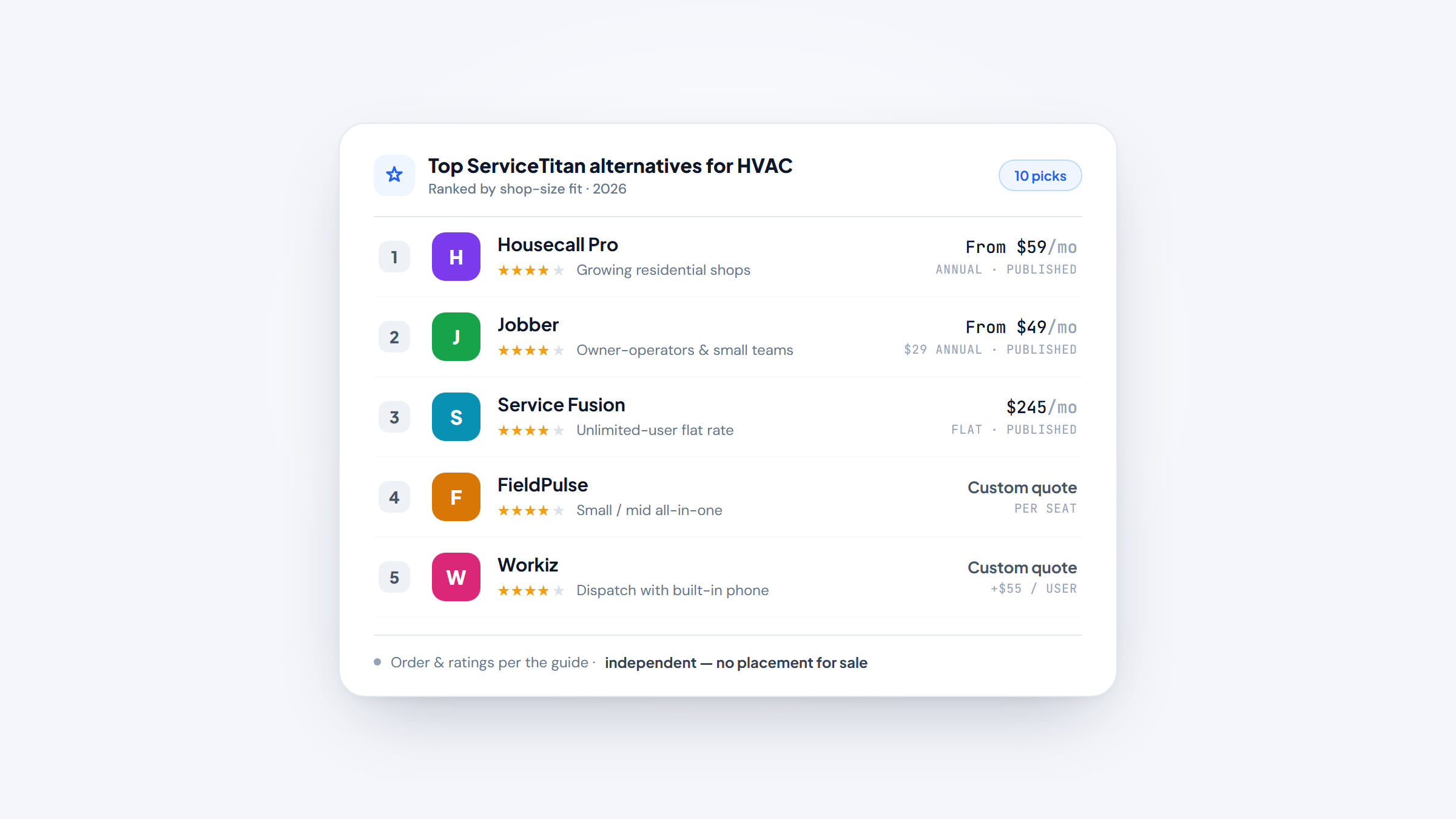
ServiceTitan runs some of the biggest HVAC, plumbing, and electrical shops in the country, and it earns that reputation on high-volume dispatch, marketing, and reporting. The trouble starts when a shop with five trucks buys software built for fifty. That is why so many contractors go looking for ServiceTitan alternatives: the pricing is a per-technician custom quote, the contract is annual, and the onboarding commonly runs two to three months before you see a return.
This guide covers the 10 best alternatives to ServiceTitan for HVAC in 2026, each with a real screenshot, verified pricing where the vendor publishes it, and honest pros and cons. These ServiceTitan competitors range from $49-per-month tools for owner-operators up to commercial platforms for mechanical contractors. Weighing competitors to ServiceTitan against the shop you actually run, not the one you might run in five years, is how you avoid overpaying.
Why Look for ServiceTitan Alternatives?
ServiceTitan is a strong product. It is just aimed at a specific kind of contractor, and the fit gets expensive fast when you are smaller than its target customer.
Cost you cannot see up front. ServiceTitan does not publish a price. Its Starter, Essentials, and The Works packages all say "Request Pricing," and cost scales per technician. A widely cited figure of $3,500 to $4,000 per month for 10 techs comes from a third-party contractor estimate (FieldCamp), not from ServiceTitan itself, so treat it as a ballpark, not a quote. Either way, that is real money for a shop working on thin margins. The ACCA notes that well-run HVAC contractors target 10 to 12 percent net overall, and 15 to 20 percent on service and repair, so every dollar spent on features you never open comes straight out of a narrow band of profit. Money tied up in unused software is money you can't put toward generating more HVAC leads.
More platform than a small shop needs. ServiceTitan bundles marketing automation, advanced reporting, and configuration depth that a two-to-eight-truck shop rarely touches. You pay for the whole thing regardless.
Onboarding and contracts. Plan for two to three months of setup and an annual commitment. One 15-tech shop on an r/HVAC thread said it left ServiceTitan over support that felt "like pulling teeth" and an app whose interface kept changing on their techs. That is one shop's anecdote, but it is a common theme: the bigger the platform, the more there is to maintain.
If any of that sounds like your situation, the alternatives below trade some enterprise horsepower for a price you can read and a setup you can finish in days.
The Best ServiceTitan Alternatives
The table below lines up all 10 tools at a glance, then each entry breaks down features, real pricing, and the trade-offs underneath. Ratings are rounded to the nearest half-star and reflect overall fit for HVAC work, not raw feature count.
Tool | Best for | Key features | Main limitation | Pricing (from) | Rating |
|---|---|---|---|---|---|
Housecall Pro | Growing residential shops | Dispatch board, card payments, review requests | Thin commercial features | $59/mo (annual) | ★★★★½ |
Jobber | Owner-operators, small teams | Quoting, scheduling, client hub | Advanced tools gate to top tier | $49/mo ($29 annual) | ★★★★½ |
Service Fusion | Unlimited-user flat rate | Dispatch, job costing, QuickBooks sync | Dated interface, add-on costs | $245/mo | ★★★★ |
FieldPulse | Small/mid all-in-one | CRM, estimates, AI dispatch add-on | No public pricing | Custom | ★★★★½ |
Workiz | Dispatch with built-in phone | Call tracking, scheduling, payments | Phone system priced separately | Custom | ★★★★½ |
FieldEdge | Deep QuickBooks integration | Real-time sync, service agreements | Quote-only, per-user cost | Custom | ★★★★ |
Procured | Quote-to-paid across trades | Quoting, dispatch, payments, chat | Newer, smaller ecosystem | $49/mo | ★★★★½ |
Kickserv | Small shops on QuickBooks | CRM, job tracking, invoicing | Lighter field features | $60/mo | ★★★★ |
BuildOps | Commercial HVAC at scale | Projects, PM contracts, dispatch | Enterprise-only, quote-based | Custom | ★★★★½ |
Simpro | Commercial with add-on modules | Estimating, project management, GPS | Steep learning curve | Custom | ★★★★ |
Every tool here handles the core HVAC daily jobs (scheduling, dispatch, work orders, invoicing), so the real decision is shop size and how much commercial or enterprise depth you need. The entries below walk through each one.
Housecall Pro

Best for: Growing residential HVAC shops.
If ServiceTitan feels like too much platform, Housecall Pro covers the same daily jobs with far less setup. You can be booking work the same week instead of waiting out a multi-month rollout.
It leans consumer-friendly, so techs pick up the mobile app without a training class.
Key features:
- Drag-and-drop dispatch board so you can move a tech to a new job without a phone call
- Built-in card and financing payments so techs close the ticket in the driveway
- Automated review requests that pull in more Google reviews without anyone chasing customers
Pricing: Plans start at $59 per month billed annually ($79 monthly) for one user, with Essentials at $149 per month annually (5 users) and Max at $299 per month annually (8 users, then $35 per extra user). A 14-day free trial runs with no card and no contract.
Pros: quick to roll out, polished mobile app, strong payment tools. Cons: per-user costs climb on higher tiers, thinner commercial features, some marketing tools cost extra.
Why it's a good ServiceTitan alternative: It runs the same residential workflow at a published, predictable price, so you skip both the custom quote and the long implementation.
Final verdict: For a growing residential contractor who wants ServiceTitan's core jobs without the enterprise weight, Housecall Pro is the safest first stop.
Jobber

Best for: Owner-operators and small crews.
Jobber goes the other direction from ServiceTitan: simple enough to run without an office admin, cheap enough to justify on a couple of trucks. Where ServiceTitan expects a rollout, Jobber expects you to start quoting jobs today.
The client hub lets homeowners approve quotes and pay online, which cuts the back-and-forth.
Key features:
- Quote-to-invoice flow so an approved estimate turns into a scheduled job and a bill without re-entry
- Client hub where customers approve work and pay online, cutting phone tag
- Automated follow-ups that nudge unpaid invoices so cash comes in faster
Pricing: Core is $49 per month ($29 per month billed annually) for one user, Connect is $139 per month ($99 annual), and Grow is $199 per month ($149 annual), with custom pricing above 15 users. Two-way texting, time tracking, and job costing sit on the Grow tier and up.
Pros: low entry price, fast to learn, clean quoting flow. Cons: advanced features gate to higher tiers, add-ons stack up, lighter reporting than ServiceTitan.
Why it's a good ServiceTitan alternative: For a small HVAC team, Jobber delivers scheduling, quoting, and payments at a fraction of the cost and none of the onboarding drag.
Final verdict: If you are a solo operator or run a few trucks, Jobber is the easiest ServiceTitan alternative to stand up and actually use.
Service Fusion

Best for: Established shops, unlimited users.
Service Fusion answers the one thing that stings most about per-technician pricing: it charges a flat rate with unlimited users on every tier. Add a seasonal tech in July and your bill does not move.
That makes the math simple for an established shop with a swinging headcount.
Key features:
- Flat-rate unlimited users so you never pay more for adding a dispatcher or a summer hire
- Job costing that shows which work orders actually made money
- QuickBooks integration that keeps the books in sync without double entry
Pricing: Starter is $245 per month ($208 billed annually), Plus is $382 per month ($325 annual), and Pro is $627 per month ($533 annual), all with unlimited users. Annual billing takes 15 percent off, paid as a lump sum at signup, and there is no contract.
Pros: unlimited users on every tier, no per-seat creep, strong QuickBooks sync. Cons: interface feels dated, VoIP and GPS tracking are paid add-ons on all tiers, higher entry price. If the flat-rate model appeals, it is worth weighing the other unlimited-user options too.
Why it's a good ServiceTitan alternative: It kills the per-technician cost that makes ServiceTitan expensive at scale, so a bigger crew runs on a fixed, knowable bill.
Final verdict: For an established HVAC shop tired of paying by the seat, Service Fusion's flat rate is the clearest reason to switch.
FieldPulse

Best for: Small to mid all-in-one teams.
FieldPulse aims at the same "everything in one place" pitch as ServiceTitan, but for small and mid-size HVAC teams that don't want enterprise pricing or an enterprise rollout. It bundles CRM, scheduling, estimates, and dispatch under one login.
Its newer AI add-ons handle after-hours dispatch, which smaller shops usually cannot staff.
Key features:
- CRM plus estimates in one system so customer history and quotes live together
- Operator AI add-on that answers and dispatches calls 24/7 without a night dispatcher
- Seat types (full-access vs field-only) that let you pay less for techs who only need the app
Pricing: FieldPulse is quote-based and seat-based, split across Essentials, Professional, and Enterprise, with the exact rate set on a demo. Add-ons like Engage VoIP, Operator AI, Payments, and Fleet are quoted separately, so build your quote around only the modules you need.
Pros: broad all-in-one feature set, flexible seat types, strong mobile app. Cons: no public pricing, add-ons raise the real cost, newer than the incumbents.
Why it's a good ServiceTitan alternative: It offers comparable breadth aimed at a smaller shop, so you get the all-in-one benefit without ServiceTitan's enterprise footprint.
Final verdict: For a growing team that wants one system instead of five apps, FieldPulse is a serious ServiceTitan alternative once you pin down the quote.
Workiz

Best for: Dispatch-heavy phone-driven shops.
Workiz starts from the phone. If your HVAC business lives on inbound calls, its built-in phone system ties every call to a job, a lead source, and a tech, which ServiceTitan charges more to match.
That call tracking tells you which ads actually ring the phone.
Key features:
- Built-in phone system that logs every call against a job and a lead source
- Dispatch board with drag-and-drop scheduling for same-day changes
- Ad-source tracking that shows which marketing dollars produce booked jobs
Pricing: Workiz is now quote-based across Standard, Pro, and Ultimate, with the first 5 users included. Extra members run $55 per month on Standard or $65 per month on Pro billed annually, and the Genius Answering phone service is sold separately.
Pros: strong call and lead tracking, dispatch-first design, transparent per-seat add cost. Cons: headline plan pricing is quote-only, phone system costs extra, feature depth trails the enterprise tools.
Why it's a good ServiceTitan alternative: For a call-driven shop, Workiz bundles phone and dispatch tightly at a smaller-shop price, no enterprise quote required to get moving.
Final verdict: If most of your revenue starts with a ringing phone, Workiz is the ServiceTitan alternative built around exactly that.
FieldEdge

Best for: QuickBooks-first HVAC contractors.
FieldEdge is a long-standing HVAC and plumbing platform whose signature is real-time, two-way QuickBooks sync. If your bookkeeping already lives in QuickBooks, that beats ServiceTitan's heavier accounting setup.
It also handles service agreements well, which matters if maintenance plans are your recurring revenue.
Key features:
- Real-time two-way QuickBooks sync so invoices and payments post without manual export
- Service-agreement management that tracks PM contracts and renewal dates
- Technician mobile app with customer history so techs walk in knowing the equipment
Pricing: FieldEdge is quote-based across Select, Premier, and Elite, with mobile licenses (2, 4, or 6) set by tier and no published rate. Add-ons like Proposal Pro and MarketingEdge are "Call for Pricing," so the total depends on your tier and headcount.
Pros: best-in-class QuickBooks sync, solid service-agreement tools, established support. Cons: no public pricing, per-user model can climb, interface feels older.
Why it's a good ServiceTitan alternative: It gives QuickBooks-based shops tighter accounting sync and service-agreement depth without ServiceTitan's scale or price.
Final verdict: For a contractor who runs on QuickBooks and lives off maintenance contracts, FieldEdge is a natural ServiceTitan alternative.
Procured

Best for: Quote-to-paid across the trades.
Procured pulls quoting, scheduling, dispatch, payments, and team chat into one flow, aimed at trades shops that want to go from estimate to paid without stitching apps together. Against ServiceTitan, its draw is a published price and a same-day start.
Pricing sits right on the homepage, so there is no quote to chase.
Key features:
- Quote-to-paid flow that carries an estimate through to a collected payment in one place
- Built-in team chat so the office and the truck stay on the same job thread
- Dispatch and scheduling in the same app the techs already use for quotes
Pricing: Solo is $49 per month for one user, Team is $75 per month for up to 5, and Business is $145 per month for 15 users (then $9 per user monthly, or $90 per user on annual billing). A 14-day free Business trial runs with no card and no contract, and Stripe processing fees apply separately.
Pros: transparent public pricing, low entry cost, quote-to-paid in one flow. Cons: smaller ecosystem than incumbents, fewer third-party integrations, newer to market.
Why it's a good ServiceTitan alternative: It replaces ServiceTitan's custom quote with a clear monthly price and covers the estimate-to-payment path a small trades shop actually runs.
Final verdict: For a shop that wants one predictable bill and a fast start, Procured is a straightforward ServiceTitan alternative to trial.
Kickserv

Best for: Small shops running on QuickBooks.
Kickserv keeps things lean: CRM, job tracking, and invoicing for small HVAC businesses that already keep their books in QuickBooks. It won't out-feature ServiceTitan, and that is the point.
The pricing is published and the learning curve is short.
Key features:
- CRM and job tracking so customer and job history stay in one record
- QuickBooks integration (Online included; Desktop as a paid add-on) that skips re-entry
- Online payments with volume-based "Kickback" discounts that lower your rate as you process more
Pricing: Start is $60 per month (5 users), Run is $119 per month (10 users), and Scale is $199 per month (20 users), with 20 percent off annual billing. QuickBooks Desktop integration adds $50 per month on the Run tier.
Pros: affordable published pricing, easy to learn, QuickBooks-friendly. Cons: lighter field and dispatch features, thinner reporting, fewer add-ons than the big platforms.
Why it's a good ServiceTitan alternative: It handles the office side of a small HVAC business at a fraction of ServiceTitan's cost, with pricing you can read before you buy.
Final verdict: For a small QuickBooks-based shop that wants the basics done well, Kickserv is a low-risk ServiceTitan alternative.
BuildOps

Best for: Commercial HVAC at scale.
BuildOps is where you look if you are leaving ServiceTitan but still run commercial mechanical work. It handles service, projects, and preventive maintenance together, which residential-first tools cannot.
It is built for contractors juggling long project timelines alongside daily service calls.
Key features:
- Project management and service in one platform so long jobs and truck rolls share a system
- Preventive-maintenance contract tracking that keeps recurring commercial revenue on schedule
- Dispatch and reporting sized for larger crews across multiple trades
Pricing: BuildOps is quote-based, described as "Custom BuildOps Pricing for Commercial Contractors," and priced by crew size, trades, and modules. Expect a discovery call, then a demo and a proposal, so the number tracks the scope you bring.
Pros: true commercial and project depth, PM contract management, built for scale. Cons: enterprise-only focus, quote-based pricing, more than a residential shop needs.
Why it's a good ServiceTitan alternative: For commercial mechanical contractors, BuildOps matches ServiceTitan's ambition on projects and maintenance while pitching itself squarely at that segment.
Final verdict: If your work is commercial HVAC and mechanical at scale, BuildOps is the ServiceTitan alternative built for that job.
Simpro

Best for: Commercial shops wanting modular add-ons.
Simpro is a commercial-scale platform (its own copy talks "five or 200 staff") built around a single base plan you extend with a-la-carte modules. That lets a growing commercial contractor buy only the pieces it uses instead of one fixed enterprise bundle.
Its estimating and project tools suit contractors doing complex quoted work.
Key features:
- Estimating and takeoffs that turn detailed scopes into priced quotes
- Project management for multi-stage commercial jobs with materials and labor tracking
- Add-on modules (Digital Forms, Simtrac GPS, SMS) so you pay only for what you use
Pricing: Simpro is quote-based, with a single base plan plus a-la-carte add-ons like Digital Forms, Maintenance Planner, Takeoffs, and Simtrac GPS. Vendor productivity claims are marketing, not verified figures, so scope the quote to the modules you will actually run.
Pros: deep estimating and project tools, modular pricing, commercial scale. Cons: steep learning curve, quote-based pricing, heavier than a service-only shop needs.
Why it's a good ServiceTitan alternative: It offers commercial-grade project and estimating depth with modular pricing, so you replace ServiceTitan without paying for modules you skip.
Final verdict: For a commercial contractor that wants to build its own feature set, Simpro is a flexible ServiceTitan alternative worth a demo.
How Much Do ServiceTitan Alternatives Cost?
The honest answer: less than ServiceTitan for most small and mid-size shops, and far more transparent. Roughly half these tools publish a price you can read today, while the commercial and enterprise options stay quote-based like ServiceTitan itself.
Tool | Entry price | Billing basis | Free trial |
|---|---|---|---|
Housecall Pro | $59/mo (annual) | Per plan, 1-user tiers | 14 days |
Jobber | $49/mo ($29 annual) | Per plan, 5-user bundles | Yes |
Procured | $49/mo | Per plan, user tiers | 14 days |
Kickserv | $60/mo | Per plan, 5-user tiers | Yes |
Service Fusion | $245/mo ($208 annual) | Flat, unlimited users | Demo |
FieldPulse | Custom quote | Per seat | Demo |
Workiz | Custom quote | Per plan, +$55/user | Yes |
FieldEdge | Custom quote | Per user, by tier | Demo |
BuildOps | Custom quote | By crew and modules | Demo |
Simpro | Custom quote | Base plan + add-ons | Demo |
Read the billing basis as closely as the headline number. Per-user tools (Housecall Pro, Jobber, FieldEdge) get pricier as you add techs, while Service Fusion's flat rate stays put no matter how many people you add. Watch the annual-vs-monthly gap too, since most of these charge noticeably less on annual billing. Whatever you land on, make sure the software cost still leaves room for a healthy markup, which is where a solid HVAC pricing guide earns its keep.
How Hard Is It to Migrate From ServiceTitan?
Switching platforms is real work, but it is measured in days for the smaller tools and weeks for the commercial ones, not the months ServiceTitan took to stand up. The effort is mostly in moving your data cleanly and getting techs comfortable.
Here is a workable sequence:
- Export your customer list, job history, price book, and open invoices from ServiceTitan before your renewal date.
- Ask the new vendor whether they offer assisted migration or import templates, since several (GorillaDesk, Housecall Pro) run imports for you.
- Rebuild your price book and service agreements in the new system, and spot-check a few records against the old data.
- Run both systems in parallel for one or two weeks so nothing in flight gets lost.
- Train techs on the mobile app first, since that is the tool they touch every day.
Do not skip the evaluation before you commit. According to Capterra's 2026 report, only about one in three software buyers count as "successful adopters," two-thirds hit implementation disruptions or purchase regret, and 89 percent of buyers who regretted a purchase had run into implementation trouble first. A short, honest trial with your own real jobs is the cheapest insurance against being in that two-thirds.
How to Choose the Right ServiceTitan Alternative for Your Needs
Match the tool to your shop, not to a feature checklist. The right answer changes with headcount, whether you do residential or commercial work, and how much you value published pricing.
Solo Operators and Small Residential Teams
If you run one to five trucks, start with Jobber, Housecall Pro, Procured, or Kickserv. All publish their pricing, all start under $60 per month, and none need a formal rollout. One solo contractor on a small-business Reddit thread said a ServiceTitan demo came back with a quote "not for solo ops," which is exactly the mismatch these tools fix. For more options in this bracket, the small-team Jobber alternatives roundup covers the cheaper end in depth.
Growing and Mid-Size Residential Shops
Once you are past 8 to 10 techs, look at FieldPulse, Workiz, or Service Fusion. FieldPulse and Workiz bundle CRM, dispatch, and call tracking for teams that have outgrown the entry tools, and the wider mid-market all-in-one picks are worth comparing. Service Fusion wins when your headcount swings seasonally and per-seat pricing hurts. Growth-stage shops also live and die by demand, so pair the software decision with steady HVAC marketing to keep the schedule full.
Commercial and Mechanical Contractors
For commercial HVAC, projects, and preventive-maintenance contracts, BuildOps and Simpro are the real ServiceTitan alternatives. Both handle multi-stage jobs and recurring maintenance that residential-first tools cannot, and both are quote-based, so budget for a discovery call and a proper implementation.
Weigh your must-haves (QuickBooks sync, unlimited users, a built-in phone, published pricing) before you sit through demos, and the shortlist usually narrows itself to two or three tools.
Where to Start Your Switch
The best ServiceTitan alternative is the one that fits the shop you run today, not the one you might run in five years. A three-truck residential outfit and a 40-tech commercial contractor need different software, and the picks above are grouped so you can jump straight to your tier: Housecall Pro, Jobber, Procured, or Kickserv for small residential; FieldPulse, Workiz, or Service Fusion in the middle; BuildOps or Simpro for commercial.
Trial two of them with your own real jobs before you sign anything, and lean on the free trials where they exist. Software only pays off if it wins back hours you can spend on the work, so once the back office is handled, put that time into demand: sharper HVAC SEO and a written HVAC marketing plan turn a smoother operation into a fuller schedule.
Frequently asked questions
For one to five trucks, Jobber, Housecall Pro, and Procured are the strongest picks. All three publish their pricing (starting at $49 to $59 per month), skip the annual contract, and stand up in days rather than months, which is the opposite of ServiceTitan's per-technician quote and multi-month onboarding.

Still comparing HVAC software?
Filter 159 vetted tools by pricing, business size, and the features your shop actually needs. No signup, no sales calls.