Top 10 FieldPulse Alternatives for HVAC Software in 2026
The 10 best FieldPulse alternatives for HVAC in 2026, with verified pricing (many public), pros and cons, and the right fit for your shop.
FieldPulse is a solid all-in-one for small and mid-size HVAC teams, so most contractors comparing FieldPulse alternatives already like the idea of one app for CRM, scheduling, estimates, and invoicing. The catch is the price tag, or the lack of one. FieldPulse now runs fully quote-based (Essentials, Professional, and Enterprise tiers, billed per seat with full-access and field-only seats), with no public numbers and no self-serve signup. It pitches itself as the tool with "no enterprise pricing," yet it makes you book a sales call just like the enterprise platforms it competes against.
That gap is why people go looking. Some want a price they can see before a demo. Others want deeper QuickBooks integration, a bigger support bench, or a tool built for exactly their shop size. This guide covers 10 alternatives to FieldPulse for HVAC, with verified pricing, real pros and cons, and a clear read on who each one fits. Every competitor to FieldPulse here is a real, current tool, priced and checked in 2026.
Why Look for FieldPulse Alternatives?
FieldPulse does a lot right, so this isn't a hit piece. But four specific gaps send contractors shopping for competitors to FieldPulse.
Pricing you can't see. Every FieldPulse plan is quote-based and seat-priced, split into full-access and field-only seats. You can't compare it to a $59/mo tool without first sitting through a sales call, which is the opposite of what a small shop wants when it's just trying to budget.
Seat math that adds up fast. Because it's priced per seat, a shop that adds a few office users and a dozen techs can watch the monthly cost climb in ways a flat-rate, unlimited-user tool like Service Fusion never does.
Depth in specific areas. Some shops want the deep real-time QuickBooks sync FieldEdge is known for, the built-in phone system Workiz ships, or the enterprise reporting and marketing stack in ServiceTitan. FieldPulse covers the basics broadly but isn't the deepest at any one of them.
Add-ons that live behind quotes too. FieldPulse's better pieces, like Operator AI for 24/7 dispatch, Engage VoIP, and Payments, are all quoted separately. The all-in-one promise gets more expensive once you switch those on, and you still won't know the number until you ask.
None of this makes FieldPulse a bad tool. It just means a contractor who values transparent pricing, or wants best-in-class depth in one area, has real reasons to compare.
The Best FieldPulse Alternatives
The 10 tools below cover every HVAC shop size, from a one-truck operator to a commercial contractor running 40 techs. The table gives you the fast comparison; the reviews under it go deeper on pricing, fit, and trade-offs. Prices are the cheapest public plan verified in 2026; "Custom" means the vendor publishes no figure and quotes you after a demo.
Tool | Best for | Key features | Main limitation | Pricing (from) | Rating |
|---|---|---|---|---|---|
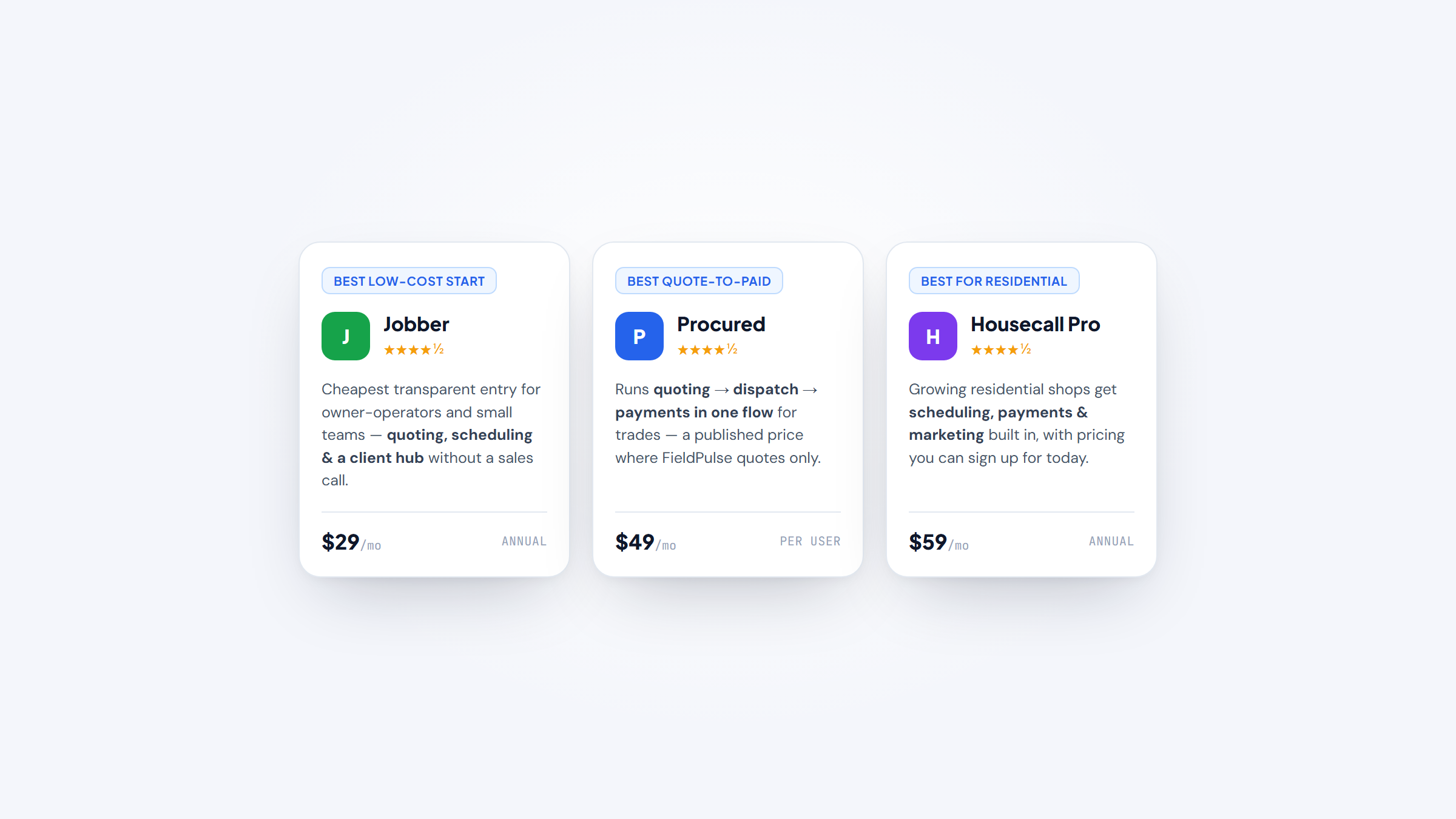
Housecall Pro | Growing residential shops | Scheduling, payments, marketing tools | Per-user costs on higher tiers | $59/mo | ★★★★½ |
Jobber | Owner-operators, small teams | Quoting, scheduling, client hub | Job-costing gated to top tier | $29/mo annual | ★★★★½ |
Workiz | Dispatch-heavy phone shops | Built-in phone, dispatch board, automation | Pricing now quote-only | Custom | ★★★★½ |
Service Fusion | Established shops, many users | Unlimited users, dispatch, QuickBooks sync | Dated interface, paid add-ons | $245/mo | ★★★★ |
ServiceTitan | High-volume enterprise contractors | Reporting, marketing, call booking | Expensive, quote-only, steep setup | Custom | ★★★★½ |
FieldEdge | QuickBooks-centric service shops | Real-time QuickBooks sync, service agreements | No public pricing, dated mobile app | Custom | ★★★★ |
Procured | Quote-to-paid trades workflow | Quoting, dispatch, payments in one | Newer, smaller ecosystem | $49/mo | ★★★★½ |
Kickserv | Small shops on QuickBooks | Job management, CRM, QuickBooks sync | Lighter feature set | $60/mo | ★★★★ |
ServiceM8 | Solo iOS-first operators | Job cards, quoting, unlimited users | iOS-first, Android app is basic | $0 (free) | ★★★★½ |
GorillaDesk | Route-based solo crews | Route scheduling, automation, invoicing | Not HVAC-native, pest/lawn roots | $49/mo | ★★★★½ |
Each tool below is described on its own merits, with the pricing that was live in 2026. Read the ones that match your shop size first.
Housecall Pro

Best for: growing residential HVAC teams
Housecall Pro is the tool most FieldPulse shoppers land on first, and for a plain reason: it shows its price. Where FieldPulse hides everything behind a quote, Housecall Pro starts at $59/mo and lets you sign up and trial it without a call.
It's polished, mobile-first, and built for residential contractors who want scheduling, payments, and light marketing in one app.
The trade-off is that its per-user costs and add-ons climb on the bigger plans, so a mid-size shop should price out its real seat count before switching.
Key features:
- Drag-and-drop dispatch board so a dispatcher can move a tech to a new job in seconds
- Integrated payments and consumer financing so techs collect on-site instead of mailing invoices
- Automated review requests and email campaigns that pull repeat work from your existing customer list
Pricing: Basic runs $59/mo billed annually ($79 monthly) for one user, Essentials is $149/mo annually for up to five, and Max is $299/mo annually for eight. There's a 14-day free trial with no card required, and card processing starts at 2.59%.
Pros: transparent public pricing, strong mobile app, deep payments and marketing tools. Cons: per-user fees on Max, marketing features cost extra, residential focus over commercial.
Why it's a good FieldPulse alternative: It delivers the same all-in-one residential workflow FieldPulse promises, but with a price you can see and a signup you can finish yourself. Contractors weighing FieldPulse competitors almost always trial this one alongside it.
Final verdict: If you run residential service and want a proven, self-serve tool, Housecall Pro is the safest first switch.
Jobber

Best for: owner-operators and small crews
Jobber sits in the same small-team lane FieldPulse targets, and it's often cheaper to start. Its annual Core plan lands at $29/mo, so a solo operator can run quoting, scheduling, and invoicing without an office admin or a training budget.
The client hub, where customers approve quotes and pay online, is one of the cleanest in the category.
The limits show as you grow. Two-way texting, time tracking, and job costing only unlock on the top Grow tier, so a shop that needs profitability data pays more than the headline price.
Key features:
- Online quote approvals so a customer signs off from their phone and the job moves straight to scheduling
- Automated payment reminders that chase overdue invoices without you lifting a finger
- A client hub that cuts "where's my invoice?" calls by giving customers self-serve access
Pricing: Core is $49/mo ($29 annually) for one user, Connect is $139/mo ($99 annually), and Grow is $199/mo ($149 annually), with custom pricing above 15 users. Plans are sold in stepped five-user bundles, and the AI Receptionist and Marketing Suite are paid add-ons.
Pros: low entry price, clean quoting and client experience, easy to learn. Cons: job costing gated to Grow, add-ons stack up, thinner for commercial work.
Why it's a good FieldPulse alternative: Jobber matches FieldPulse's small-team, all-in-one pitch at a lower, fully public entry price, which makes it one of the most common alternatives to FieldPulse for HVAC owner-operators. If you want a deeper look, this Jobber alternatives breakdown compares it head to head.
Final verdict: For a one to five-person shop that wants a slick quote-to-cash flow on a budget, Jobber is hard to beat.
Workiz

Best for: dispatch-first, phone-driven shops
Workiz was built around the phone. Its dispatch board and built-in phone system record calls, tie them to jobs, and show which ads drive booked work, which is more call-center depth than FieldPulse ships out of the box.
That makes it a strong fit for HVAC, appliance, and garage-door shops that live on inbound calls.
The downside is that Workiz has moved to quote-only pricing, so like FieldPulse, you now request a number instead of seeing one. The only public figures are per-seat overages above the first five users.
Key features:
- Built-in phone system that logs every call against the customer and job so nothing gets lost
- Ad and lead source tracking that shows which marketing dollars actually book jobs
- Automated dispatch and job reminders that cut no-shows and missed windows
Pricing: Standard, Pro, and Ultimate are all "Request pricing." The first five users are included; extra members run $55/mo (Standard) or $65/mo (Pro) billed annually, and the Genius Answering phone service is sold separately.
Pros: best-in-class call handling, strong lead tracking, dispatch built for volume. Cons: no public pricing, phone add-on costs extra, overkill for a solo tech.
Why it's a good FieldPulse alternative: If your gripe with FieldPulse is dispatch and phone depth rather than price, Workiz gives you a purpose-built call and dispatch engine. It's a frequent name among FieldPulse competitors for high-call-volume shops.
Final verdict: Choose Workiz when inbound calls drive your business and you'll trade price transparency for dispatch muscle.
Service Fusion

Best for: established shops with many users
Service Fusion answers FieldPulse's per-seat model with a flat rate: every plan includes unlimited users. For a 20-person shop, that math flips hard in Service Fusion's favor, since you're not paying for each new tech or office hire.
It handles dispatch, work orders, estimates, and QuickBooks sync for established residential companies.
The interface looks dated next to Housecall Pro, and VoIP and GPS fleet tracking are paid add-ons on every tier, including the top one. But for a growing team, unlimited users often wins.
Key features:
- Unlimited-user pricing so adding techs and dispatchers never raises your bill
- Two-way QuickBooks integration that keeps invoices and payments in sync without re-entry
- Customizable estimates and progressive invoicing for larger residential jobs
Pricing: Starter is $245/mo ($208 annually), Plus is $382/mo ($325 annually), and Pro is $627/mo ($533 annually), all with unlimited users. Annual billing saves 15% as a lump sum at signup, and there's no contract.
Pros: unlimited users on every plan, strong QuickBooks sync, no per-seat penalty. Cons: dated interface, VoIP and GPS cost extra, higher entry price.
Why it's a good FieldPulse alternative: For a mid-size shop where FieldPulse's seat count would balloon the bill, Service Fusion's flat unlimited-user pricing is the clearest reason to switch. It's one of the strongest competitors to FieldPulse on cost predictability.
Final verdict: If you're adding techs fast and hate per-seat math, Service Fusion's flat rate pays for itself.
ServiceTitan

Best for: high-volume enterprise contractors
ServiceTitan is the enterprise end of the market FieldPulse says it avoids. It's the deepest platform here for reporting, marketing attribution, call booking, and financing, built for shops running high residential and commercial volume.
Techs like its integrations: one r/HVAC tech who called FieldPulse "decent" also praised ServiceTitan's MeasureQuick and QuickBooks links (anecdotal, from one Reddit thread).
The cost is real. Pricing is fully custom and per-technician, and setup is a project, not a weekend. A widely shared "$3,500 to $4,000/mo for 10 techs" figure comes from contractor firm FieldCamp, not ServiceTitan, so treat it as an estimate.
Key features:
- Deep reporting and dashboards that show job-level and technician-level profitability
- Marketing and call-booking tools that tie ad spend to booked, completed revenue
- Financing and pricebook features that lift average ticket on replacement jobs
Pricing: Fully quote-based and priced per technician across Starter, Essentials, and The Works packages, all "Request Pricing." ServiceTitan publishes no rate, so budget for a demo and a formal proposal.
Pros: unmatched depth, strong reporting and marketing, residential plus commercial scale. Cons: expensive, quote-only, heavy implementation.
Why it's a good FieldPulse alternative: If you've outgrown FieldPulse's depth and can absorb the cost, ServiceTitan is the upgrade path for serious volume. This ServiceTitan alternatives guide covers the flip side if the price scares you.
Final verdict: Pick ServiceTitan when scale and reporting depth matter more than a low, transparent price.
FieldEdge

Best for: QuickBooks-centric service shops
FieldEdge's signature is its deep, real-time, two-way QuickBooks sync, which is stronger than what FieldPulse offers. If your books live in QuickBooks and re-entry is your daily headache, that alone can settle the decision.
It's a long-standing HVAC and plumbing platform with solid service-agreement management for recurring PM work.
Like FieldPulse, though, FieldEdge is quote-only, and its mobile app feels dated next to newer tools. You'll request pricing rather than see it, and add-ons like Proposal Pro are quoted separately.
Key features:
- Real-time two-way QuickBooks sync so invoices, payments, and customers stay matched automatically
- Service-agreement tracking that flags due PM visits and protects recurring revenue
- A price-book and flat-rate feature that keeps tech quotes consistent in the field
Pricing: Quote-based across Select, Premier, and Elite tiers, with mobile licenses bundled two, four, or six by tier. Add-ons like Proposal Pro and MarketingEdge are "Call for Pricing," so there's no public number.
Pros: best-in-class QuickBooks sync, strong service agreements, HVAC-proven. Cons: no public pricing, dated mobile app, add-ons quoted separately.
Why it's a good FieldPulse alternative: For a shop where QuickBooks accuracy outranks everything, FieldEdge's sync is a concrete reason to leave FieldPulse. It's a natural pick among alternatives to FieldPulse for accounting-heavy contractors.
Final verdict: Choose FieldEdge if flawless QuickBooks sync is the feature you'd switch tools to get.
Procured

Best for: quote-to-paid trades workflow
Procured takes the same all-in-one idea FieldPulse sells and puts a public price on it, starting at $49/mo. It pulls quoting, scheduling, dispatch, payments, and team messaging into one place for HVAC, plumbing, electrical, and roofing shops.
The signup is self-serve with a 14-day trial, no card, and no contract.
As a newer platform, its ecosystem and third-party integrations are smaller than what ServiceTitan or Housecall Pro offer. But for a shop that wants a straight quote-to-paid flow at a visible price, it lands cleanly.
Key features:
- One-flow quoting to payment so a job moves from estimate to paid without switching apps
- Built-in dispatch and scheduling that keeps techs and the office on the same board
- Integrated payments so customers pay the quote directly and cash flow tightens
Pricing: Solo is $49/mo for one user, Team is $75/mo for up to five, and Business is $145/mo for 15 users (then $9/user/mo, or $90/user annually). The Business trial is 14 days with no card, and Stripe processing fees apply separately.
Pros: transparent public pricing, genuine all-in-one flow, no-card trial. Cons: newer and smaller, fewer integrations, less brand track record.
Why it's a good FieldPulse alternative: Procured matches FieldPulse's all-in-one pitch while doing the one thing FieldPulse won't: showing the price up front. That makes it a direct answer for contractors who left over quote-only pricing.
Final verdict: If you want FieldPulse's breadth with a number you can see today, Procured is worth a trial.
Kickserv

Best for: small shops running QuickBooks
Kickserv is a straightforward, affordable option for small HVAC businesses that keep their books in QuickBooks. It covers CRM, job management, scheduling, and invoicing without the seat-based quote wall FieldPulse puts up.
Its five-user Start plan at $60/mo makes it easy to price a small team.
It's lighter on advanced features than FieldPulse, so a shop that needs deep automation or detailed reporting will feel the ceiling. For basic job and customer management, though, it's clean and cheap.
Key features:
- Two-way QuickBooks sync that keeps invoices and customers aligned across both tools
- Simple job scheduling and status tracking a small office can run without training
- A customer CRM that stores history so techs walk in knowing the account
Pricing: Start is $60/mo for five users, Run is $119/mo for 10, and Scale is $199/mo for 20, with 20% off annual billing. A QuickBooks Desktop integration adds $50/mo on Run, and a "Kickback" discount kicks in at higher payment volume.
Pros: public per-user pricing, solid QuickBooks sync, easy learning curve. Cons: lighter feature set, thinner reporting, fewer integrations.
Why it's a good FieldPulse alternative: For a small shop that found FieldPulse too much tool and too opaque a price, Kickserv's cheap, transparent plans are a sensible step down. It ranks among the simpler competitors to FieldPulse for QuickBooks users.
Final verdict: Kickserv suits a small QuickBooks-based shop that wants the basics done well and priced clearly.
ServiceM8

Best for: solo, iOS-first operators
ServiceM8 has the most contractor-friendly entry point on this list: a free plan covering 30 jobs a month for one user. For a one-truck operator testing whether software beats a paper diary, that removes all risk, which FieldPulse's quote wall can't match.
Paid plans are priced by jobs per month, not per seat, so users are unlimited on every tier.
The big caveat is that it's iOS-first. The full experience lives on iPhone and iPad; the Android "Lite" app is basics-only, so an Android crew should look elsewhere.
Key features:
- Job cards with photos, notes, and signatures so the full job history travels with the tech
- Quoting and invoicing from the phone so a tech closes and bills before leaving the driveway
- Unlimited users on paid plans so office staff and techs cost nothing extra to add
Pricing: The free plan covers 30 jobs a month for one user; Starter is $29/mo (50 jobs), Growing is $79/mo (150 jobs), Premium is $149/mo (500 jobs), and Premium Plus is $349/mo (1,500+ jobs). Every paid plan includes unlimited users.
Pros: genuinely free entry tier, unlimited users, strong job-card workflow. Cons: iOS-first, weak Android app, priced by job volume.
Why it's a good FieldPulse alternative: For a solo or two-person iPhone shop, ServiceM8's free tier and job-based pricing beat committing to a FieldPulse quote sight unseen. This ServiceM8 alternatives guide helps if Android support is a dealbreaker.
Final verdict: ServiceM8 is the pick for a small iOS-based operator who wants to start free and scale by job count.
GorillaDesk

Best for: route-based solo crews
GorillaDesk shines when your day is a route, not a scattered set of calls. Its scheduling, automation, and invoicing are built around recurring, route-based visits, with a public $49/mo entry price that FieldPulse won't show you.
It handles reminders, follow-ups, and payments cleanly for small crews.
The honest caveat: GorillaDesk grew up in pest, lawn, and pool service, so it isn't HVAC-native. A shop with heavy service agreements or QuickBooks depth will notice the gaps, but a route-heavy PM operation may not.
Key features:
- Route-based scheduling that groups recurring visits so techs drive less and finish more
- Automated reminders and follow-ups that keep recurring customers on schedule
- Built-in invoicing and payments so route stops get billed the same day
Pricing: Basic is $49/mo ($539/yr), Pro is $99/mo ($1,089/yr), and Growth is $149/mo ($1,639/yr). SMS is a $5/mo per-number add-on plus credits, and there are no setup fees, contracts, or migration charges.
Pros: low public entry price, strong route automation, free migration. Cons: not HVAC-native, lighter on service agreements, pest/lawn heritage.
Why it's a good FieldPulse alternative: If your HVAC work is route-driven PM rather than one-off dispatch, GorillaDesk's automation and visible pricing make it a practical FieldPulse alternative. It's one of the more affordable alternatives to FieldPulse for recurring-visit shops.
Final verdict: Pick GorillaDesk when recurring routes define your schedule and a low, clear price matters more than HVAC-specific depth.
How Much Do FieldPulse Alternatives Cost?
FieldPulse's pricing is quote-only, so the honest answer to "what will it cost?" is "book a call and find out." The alternatives split cleanly: some publish a price you can act on today, and some make you request one. That difference alone drives a lot of switching decisions.
The table below shows the cheapest public entry point, how each tool bills, and whether you can trial it first. For quote-based tools, "Custom quote" means no dollar figure is published; you'll get a number after a demo.
Tool | Entry price | Billing basis | Free trial |
|---|---|---|---|
ServiceM8 | $0 (free) | By jobs per month, unlimited users | 14-day paid trial |
Jobber | $29/mo annual | Per plan, stepped 5-user bundles | Yes |
Procured | $49/mo | Per user (tiered seat bundles) | 14 days, no card |
GorillaDesk | $49/mo | Per plan, route-based | Yes |
Housecall Pro | $59/mo annual | Per plan, +per-user on top tier | 14 days, no card |
Kickserv | $60/mo | Per plan (5/10/20 users) | Yes |
Service Fusion | $245/mo | Flat rate, unlimited users | Demo-led |
Workiz | Custom quote | Per seat above first 5 users | Trial available |
FieldEdge | Custom quote | Per user, tiered licenses | Demo-led |
ServiceTitan | Custom quote | Per technician | Demo-led |
Read the billing basis as closely as the headline price. A flat-rate tool like Service Fusion costs more to start but stays flat as you hire, while a per-seat or per-technician tool can look cheap at the entry point and climb fast. Getting your service prices set fairly first makes it easier to see which software your margins can actually carry.
How to Switch From FieldPulse Without Losing Data
Migrating field-service software is mostly about protecting your customer list, open jobs, and billing history. Rushing it is how shops lose data or double-book techs during the changeover. Move deliberately, in this order.
- Export your FieldPulse data. Pull customers, job history, open estimates, and any recurring service agreements to CSV before you cancel anything.
- Clean the export. Fix duplicate contacts and dead records now, so you import a tidy list instead of hauling old mess into the new tool.
- Import in a sandbox first. Load the data into a trial or test account and confirm names, addresses, and balances landed in the right fields.
- Reconnect your integrations. Re-link QuickBooks, your payment processor, and any phone system, then run one test invoice end to end.
- Run both tools for one pay cycle. Keep FieldPulse live while the new tool handles real jobs for a week or two, then cut over once nothing's missing.
Tell your techs before, not during. A quick walkthrough of the new mobile app the day before cutover prevents the "how do I close this job?" calls that stall your first week. Once the new system holds a full billing cycle clean, close the FieldPulse account.
How to Choose the Right FieldPulse Alternative for Your Needs
The right pick depends on your shop size and what pushed you off FieldPulse in the first place. Match your situation to the tools below instead of chasing the longest feature list.
Solo or two-person shop. Start with ServiceM8's free tier or GorillaDesk if your work is route-based. Both give you real software without a quote call or a big monthly commitment.
Growing residential team (3 to 15 techs). Housecall Pro and Jobber are the workhorses here, both with public pricing and self-serve trials. Procured fits if you want an all-in-one quote-to-paid flow at a visible price.
Established shop hiring fast. Service Fusion's unlimited-user flat rate beats per-seat pricing once you pass a dozen users. Kickserv works for a smaller QuickBooks-based team that wants basics done cheaply.
High-volume or commercial contractor. ServiceTitan and FieldEdge bring the depth, at a quote-only price. Choose ServiceTitan for reporting and marketing scale, FieldEdge for QuickBooks-first accuracy.
Whatever your size, the smart move is to shortlist and trial carefully. According to Capterra's 2026 buying report, roughly two-thirds of software buyers hit implementation disruptions or purchase regret, while the buyers who succeed usually reach a decision within about three months. Contractors on Reddit echo this from the trenches: in one thread on Reddit, shops leaving Housecall Pro over price creep and flaky QuickBooks sync named FieldPulse, Workiz, and Jobber as the tools they trialed in the same band (anecdotal, but a common pattern).
Trial two or three, run them on your own jobs, and check the QuickBooks sync and mobile app before you commit. The tool that wins on your real workflow beats the one that wins on a feature chart.
Ready to Replace FieldPulse
FieldPulse's biggest weakness for many shops isn't the software, it's the quote wall in front of the price. If that's what sent you looking, the transparent-pricing tools solve it outright: Housecall Pro from $59/mo, Jobber from $29/mo annual, Procured from $49/mo, and ServiceM8 free to start. If you want depth over a low price, ServiceTitan and FieldEdge deliver it, quote and all.
Pick two or three that match your shop size, trial them on live jobs, and confirm the pieces that actually run your day: dispatch, QuickBooks sync, and the mobile app. AI-driven dispatch is worth a look too, since features like FieldPulse's Operator AI are spreading fast across this category. The SBA's Office of Advocacy found small-business AI use climbed from 6.3% to 8.8% in just six months, so the gap between small shops and big ones on this tech is closing. Software you can see, trial, and grow into will always beat a black-box quote.
Once your operations tool is set, pair it with a plan to keep the schedule full. Guides on generating more HVAC leads, building a full marketing plan, running HVAC marketing year round, and ranking in local search results help the new system pay for itself.
Frequently asked questions
For a solo or small residential shop, Housecall Pro (from $59/mo) and Jobber (from $29/mo annual) are the most common picks, since both show public pricing and let you trial before buying. A one-truck operator can also start free on ServiceM8, which covers 30 jobs a month at no cost. All three skip the quote call FieldPulse requires, so you can budget without talking to sales.

Still comparing HVAC software?
Filter 159 vetted tools by pricing, business size, and the features your shop actually needs. No signup, no sales calls.